The Summer Radar Lit Up Over the Capitol: Washington's 1952 UFO Flap
In July 1952, radar at National Airport and Andrews tracked unknowns over the White House, jets chased lights they couldn't catch, and the Air Force held its biggest press conference since WWII. Blue Book's own chief said it stayed unknown.
Case file● Open
- Case no.
- VUF-2609-402B
- Filed
- Updated
- Read time
- 8 min
- Format
- article
- Filed by
- ViralUFOs Admin
- Class.
- Unclassified // Public
Contents· 9 sections
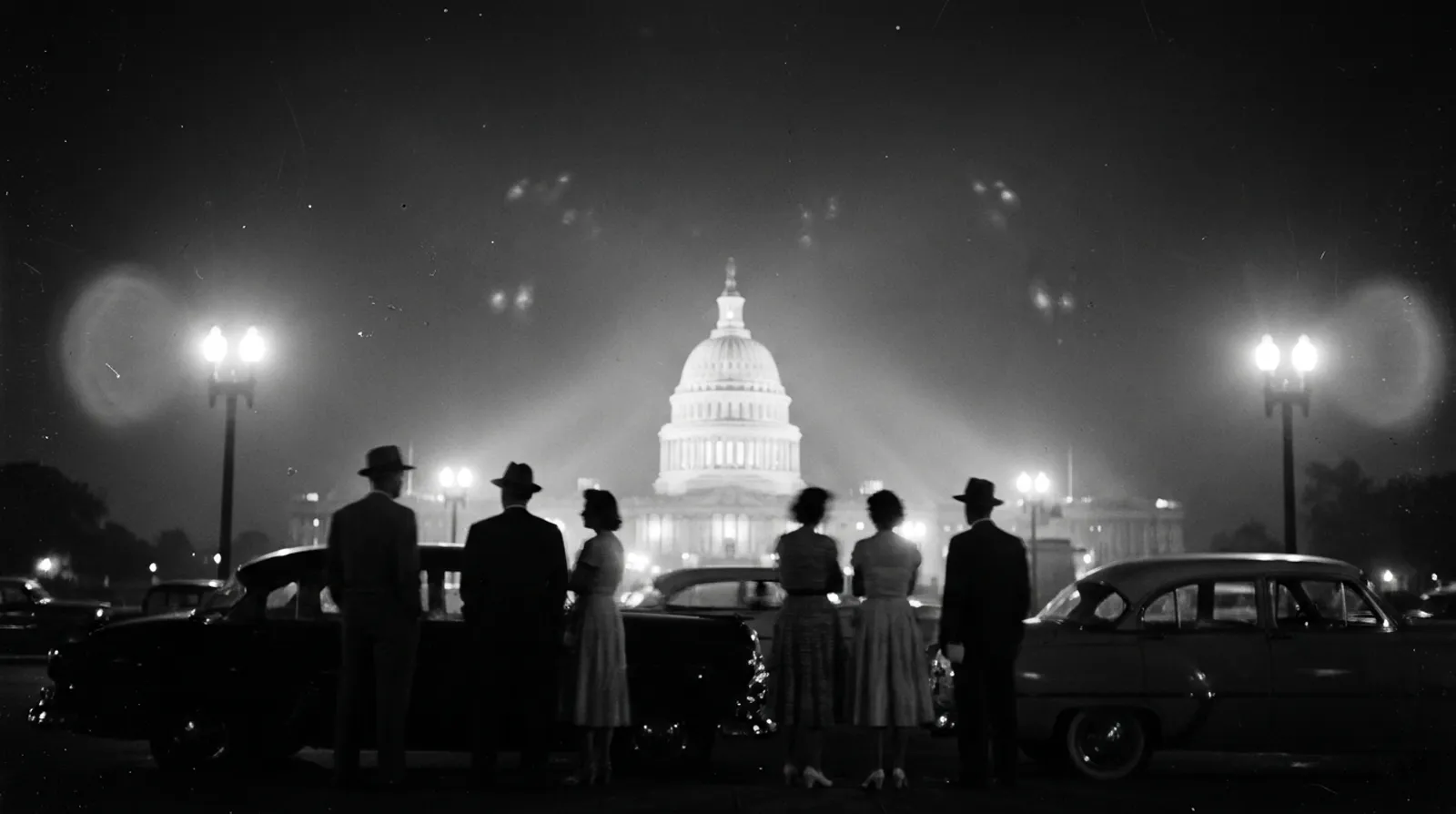
It's 11:40 p.m. on Saturday, July 19, 1952. In the Air Route Traffic Control radar room at Washington National Airport, one controller is watching the scope while the rest of the shift is out of the room.
Seven targets appear near Andrews Air Force Base. No flights are scheduled there. They loaf along at 100 to 130 miles an hour, then two of them streak off the edge of the scope.
He yells for the senior controller. A technician checks the set. It's working fine. Over the next few hours, the blips wander into the prohibited airspace over the White House and the Capitol, according to the account later published by the man who ran the Air Force's UFO project.
This is how the most public UFO event of the Cold War began. Not with a blurry photo, but with professional radar operators at three facilities calling each other on the intercom and saying: you seeing this too?
Three radars, one sky
Washington National had two radars in 1952: a long-range set in the Air Route Traffic Control (ARTC) center and a shorter-range set in the control tower. Andrews AFB, about ten miles to the east, had its own. All of them were tied together by intercom, as Capt. Edward J. Ruppelt described in his 1956 memoir, The Report on Unidentified Flying Objects.
That matters, because it means the first night wasn't one confused operator. According to Ruppelt, the tower and Andrews both reported unidentified targets on their own scopes, with the same pattern: slow drift, then a sudden burst of speed. One target, he wrote, was clocked at 7,000 miles an hour.
Controllers later identified in news accounts included Edward Nugent at the scope and senior controller Harry Barnes, according to the Seattle Times and the local history site Ghosts of DC.
Then the pilots started talking.
Shortly after midnight, ARTC asked a Capital Airlines crew departing National to keep an eye out. The pilot, identified in press accounts as Capt. S.C. "Casey" Pierman, suddenly called out: "There's one, off to the right, and there it goes." Ruppelt wrote that the controller watching the scope saw a target to the right of the airliner vanish at the same moment. Over the next fourteen minutes, the pilot reported six more lights.
Around 3 a.m., interceptors were finally requested from New Castle County AFB in Delaware. Andrews' runways were closed for repairs, according to the Seattle Times. By the time an F-94 arrived near daylight, the targets were gone.
Round two: they came back
Exactly one week later, on Saturday, July 26, it happened again.
About 10:30 p.m., the same controllers picked up the same kind of slow-moving targets, this time strung in an arc around the city from Herndon, Virginia, to Andrews, according to Ruppelt. This time they were ready. They marked every blip with a plastic marker on the 24-inch scope and called the tower and Andrews to confirm.
This time the Air Force also had people in the room: Maj. Dewey Fournet from the Pentagon, Navy radar specialist Lt. John Holcomb, and press officer Al Chop.
By midnight, two F-94s from New Castle were airborne. Reporters in the radar room were asked to leave, supposedly because intercept procedures were classified. Ruppelt, who called that pretext "absurd," wrote that the real reason was that people in the room thought this might be the night a pilot finally got a close look, and they didn't want the press watching.
As the jets arrived, the targets dropped off the scopes. The fighters searched, found nothing, and went home. Then the targets came back. When a second pair of F-94s arrived, the controllers vectored them toward group after group of blips, and each time the lights sped off before the jets could close.
The pilot was Lt. William Patterson, a Korean War veteran. Ruppelt quotes his statement to the press:
"I was at my maximum speed, but even then I had no closing speed. I ceased chasing them because I saw no chance of overtaking them."
The headlines that Monday were exactly what the Pentagon didn't want: "FIERY OBJECTS OUTRUN JETS OVER CAPITAL," Ruppelt recalled, along with "JETS ALERTED FOR SAUCERS." The Cedar Rapids Gazette went with "SAUCERS SWARM OVER CAPITAL."
The phone call from the White House
The next morning, Ruppelt wrote, President Truman's air aide, Brig. Gen. Robert Landry, called Air Force intelligence at the president's request to find out what was going on. The call landed on Ruppelt's desk. He told Landry the targets could have been caused by weather, "but that we had no proof."
That line is the whole story in miniature. Weather was a hypothesis. It was about to become the headline.
The press conference that made it go away
On Tuesday, July 29, at 4 p.m., Maj. Gen. John A. Samford, the Air Force's Director of Intelligence, faced the press at the Pentagon. Ruppelt called it "the largest and longest" press conference the Air Force had held since World War II.
The explanation on the table was a temperature inversion: a layer of warm, moist air that can bend radar beams and paint false targets. Samford's own framing, according to the Seattle Times, wobbled. He called it a possibility, then "about a 50-50 proposition," then "probable."
The radar questions went to Capt. Roy James of the Air Technical Intelligence Center, who, Ruppelt wrote, had arrived in Washington that morning and knew little more than what he'd read in the papers. Fournet and Holcomb, the two officers who had actually watched the targets and weren't convinced they were weather, were, in Ruppelt's words, "extremely conspicuous by their absence."
It worked anyway. The next morning, Ruppelt wrote, headlines read "AIR FORCE DEBUNKS SAUCERS AS JUST NATURAL PHENOMENA." Reports to Blue Book dropped from about 50 a day to about 10 within a week, according to the Seattle Times.
But Samford also said something at a July 1952 press conference that rarely made the headlines. Ruppelt preserved it:
"However, there have remained a percentage of this total, about 20 per cent of the reports, that have come from credible observers of relatively incredible things. We keep on being concerned about them."
The official explanation, fairly stated
The inversion case is not silly. Washington summers are hot and humid, and anomalous propagation was a known radar headache in the 1950s. In 1953, a Civil Aeronautics Administration technical study of unidentified targets on air traffic control radars concluded the Washington returns were consistent with temperature inversions, according to the Seattle Times.
The visual sightings also got shakier under scrutiny. Ruppelt himself reported that the Andrews tower operators who described a "huge fiery-orange sphere" later said they had probably seen a star, though he added that astronomical charts showed no especially bright star in that spot and that he'd heard from "a good source" the men had been "persuaded" a bit. An F-94 pilot later said in an official report that he'd seen a ground light reflecting off haze. A veteran airline pilot told Ruppelt that the area around Washington had so many lights you could always find a "mysterious" one.
And Ruppelt noted that although the Washington and Andrews radar coverage overlapped, all three radars caught a target at the same moment only once.
The gap
Now the other side of the ledger, also from Ruppelt.
There was an inversion on every night of the sightings, he wrote, but by the Air Defense Command's own method of measuring strength, it was never strong enough to affect radar the way inversions normally do. And hardly a night passed in June, July or August 1952 without an inversion over Washington, yet the slow, "solid" targets showed up on only a few nights.
Then there are the operators. These were controllers who brought thousands of passengers a day into National Airport. They told the Bolling AFB intelligence officer that the returns looked like radar bouncing off hard, solid objects. Fournet told Ruppelt that everyone in the radar room was convinced the targets were "very probably caused by solid metallic objects." Weather returns were on the scope too, he said, and the controllers knew to ignore them.
Ruppelt's verdict is the one that should have led every newspaper: "So the Washington National Airport Sightings are still unknowns."
That was 1956. By the time Blue Book shut down in 1969, the case was logged as a weather-related radar event, according to Ghosts of DC. The explanation the project's own chief rejected became the final answer anyway.
What we know, and what we don't
What we know
- Radar at Washington National and Andrews AFB tracked unidentified targets on July 19–20 and July 26–27, 1952, and F-94 interceptors were sent both weekends.
- Airline and military pilots reported lights in locations that matched radar returns, according to Blue Book's chief.
- The Air Force publicly floated a temperature inversion explanation at a July 29 press conference, and the press ran with it.
What we don't
- Whether the inversions on those nights were strong enough to produce what controllers saw. Ruppelt said they weren't.
- Why the targets apparently vanished when jets arrived and returned when they left.
- What, if anything, solid was over the capital those nights.
The record versus the headline
Strip away the saucer mania and what's left is a paperwork problem. Blue Book's chief couldn't get a staff car to investigate the first night, by his own account, and flew back to Dayton in frustration. The officers who witnessed the second night weren't put in front of reporters. A hypothesis became a headline, and the headline became history.
Ruppelt's conclusion was blunt: the press interest was fueled by Air Force reluctance to share information, and that reluctance came from "simply not having gone out to find the answers."
So here's the question: if the professionals on the scopes in 1952 said "solid," and the Pentagon said "weather," whose read would you trust, and why?
Sources
- The Report on Unidentified Flying Objects, by Edward J. Ruppelt (full text) — Doubleday, 1956 (Project Gutenberg edition)
- Project Blue Book: Unidentified Flying Objects — U.S. National Archives and Records Administration
- Something in the air: 50 years ago, UFOs streaked over D.C. — The Seattle Times, 2002
- 1952 Washington UFO Sightings: Jets Scrambled Over the Capitol — Ghosts of DC, 2018
- When UFOs Buzzed the White House and the Air Force Blamed the Weather — History.com, Dave Roos
End of file · VUF-2609-402B
Indexed under
- #project blue book
- #air force
- #radar
- #cold-war
- #washington-dc
- #1952
- #f-94
Filed by · VUF-2609-402B
ViralUFOs Admin
ViralUFOs Editorial · Field Desk
The ViralUFOs editorial team investigates UFO reports, ufology research, and UAP news with an evidence-first commitment — separating documented fact from hypothesis.
About the deskField Gear · The Depot
Gear for the field
- FG-01
- FG-02
- FG-03
- FG-04







01Related files
 Modern EncountersVUF-2610-EBA6JAL Flight 1628: The 747 Captain Who Said a 'Mother Ship' Shadowed Him Over AlaskaOn November 17, 1986, a Japan Air Lines cargo 747 crew reported lights pacing their jet across Alaska. Controllers saw a blip. The FAA investigated, then blamed a radar glitch. The paperwork it released tells a stranger story.Oct 15, 2026 · 7 min read
 Modern EncountersVUF-2610-0B3EAriel School, 1994: Sixty-Two Children, One Field, and the Story They Still TellDuring a morning break in 1994, dozens of schoolchildren in Zimbabwe said something landed beside their playground. A BBC reporter, a UFO researcher and a Harvard psychiatrist came to listen. Thirty years later, most of those witnesses, now adults, haven't changed their story.Oct 14, 2026 · 6 min read
 Modern EncountersVUF-2610-9730Belgium's Black Triangles: The Night NATO F-16s Chased Something They Never SawBetween 1989 and 1990, thousands of Belgians reported dark triangles with lights at the corners. Then radar caught something, two F-16s scrambled, and the Belgian Air Force did what no air force does: it published the data.Oct 8, 2026 · 7 min read