JAL Flight 1628: The 747 Captain Who Said a 'Mother Ship' Shadowed Him Over Alaska
On November 17, 1986, a Japan Air Lines cargo 747 crew reported lights pacing their jet across Alaska. Controllers saw a blip. The FAA investigated, then blamed a radar glitch. The paperwork it released tells a stranger story.
Case file● Open
- Case no.
- VUF-2610-EBA6
- Filed
- Updated
- Read time
- 7 min
- Format
- article
- Filed by
- ViralUFOs Admin
- Class.
- Unclassified // Public
Contents· 9 sections
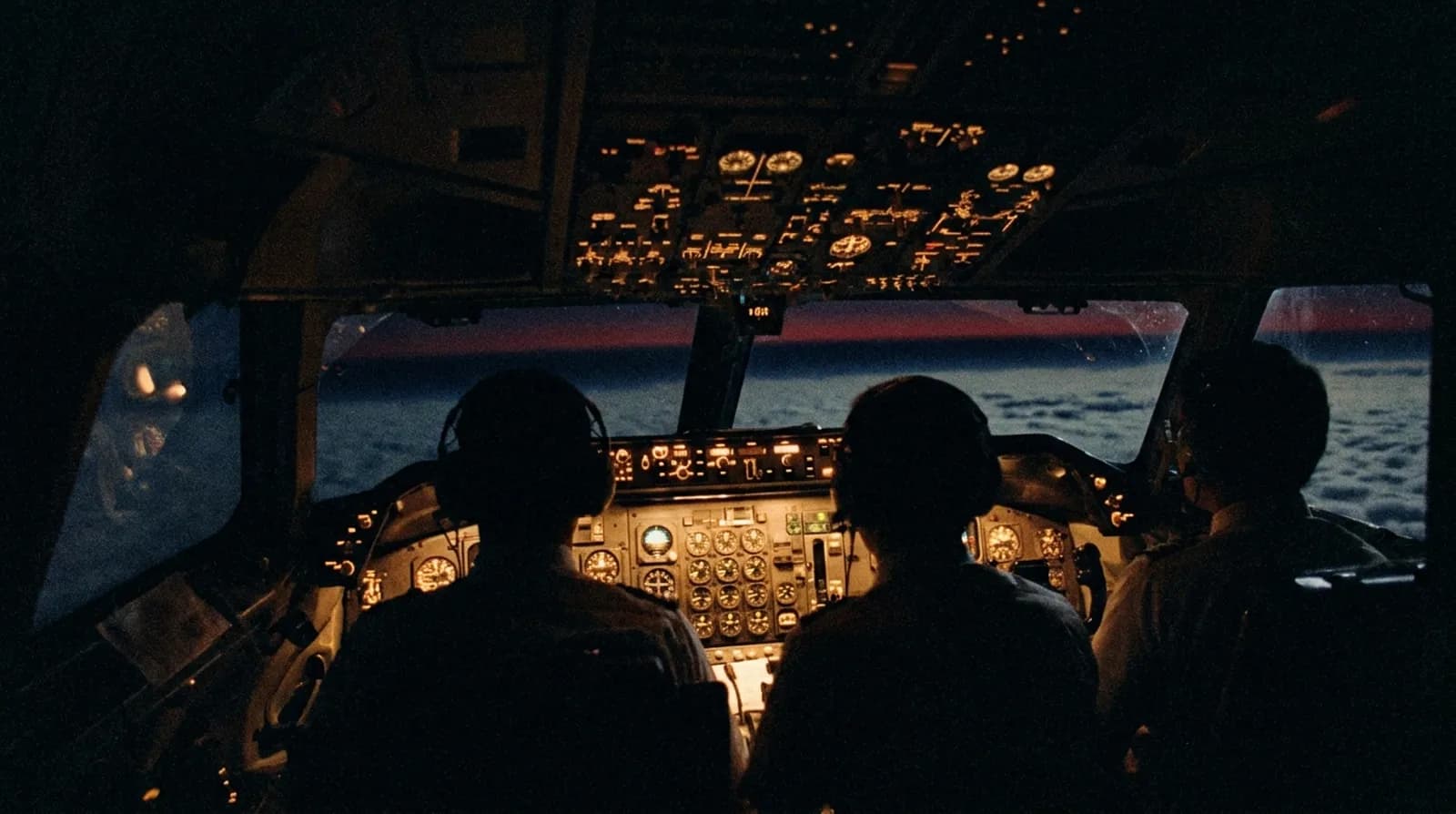
It's a little after 5 p.m. on November 17, 1986, and it's already pitch dark over northeastern Alaska.
Japan Air Lines Flight 1628, a Boeing 747 freighter, is at 35,000 feet. It left Paris with a hold full of French wine, stopped in Reykjavik, and is crossing the top of the world toward a fuel stop in Anchorage, then Tokyo. The crew has just checked in with Anchorage Center.
Then Capt. Kenju Terauchi notices lights. Off the left nose, about 2,000 feet below, moving in the same direction at exactly the same speed as his jet.
He thinks they're military aircraft. He asks Anchorage who else is out there. The answer, he later wrote: nobody.
"Like two bear cubs playing"
The best account we have is Terauchi's own. He wrote a long personal statement, translated by an FAA Alaskan Region staff member and received by the FAA on January 2, 1987. The Black Vault obtained it through FOIA.
According to that statement, the lights held their position for several minutes. Then "the two lights began to move in a manner different from ordinary aircraft maneuvers, like two bear cubs playing with each other."
Terauchi grabbed his camera. He wrote that the autofocus kept hunting and never locked, and that when he switched to manual the shutter wouldn't work. Then the aircraft started to vibrate, and he put the camera away.
About seven minutes in, he wrote, "most unexpectedly two spaceships stopped in front of our face, shooting off lights." The cockpit lit up. He said he felt warmth on his face. He estimated the objects were 500 to 1,000 feet ahead, each about the size of a DC-8's body.
"It is impossible for any man-made machine to make a sudden appearance in front of a jumbo jet that is flying 810 kilometers per hour and to move along in a formation paralleling our aircraft."
He also wrote that VHF radio transmission and reception were "extremely difficult" for ten or fifteen minutes while the objects were close, then cleared when they left.
Green on the weather radar
When the lights moved off to the left, Terauchi asked Anchorage if they had anything on radar. Anchorage said no.
So he tried his own. He set the 747's digital weather radar to a 20-mile range, he wrote, and "there it was, on the screen, a large, green, and a round object" seven or eight miles out, right where he was looking. Normally, he added, another aircraft paints red.
Over Fairbanks, against the city lights, Terauchi wrote that he looked back at a pale white light trailing them and saw "a silhouette of a gigantic spaceship." In a UPI interview weeks later, he described it as "two times bigger than an aircraft carrier" and sketched it as resembling "a large shelled walnut."
The crew asked to turn away. Anchorage approved a descent to 31,000 feet and a 360-degree turn, according to UPI. The crew said the object stayed with them, and the lights reportedly followed the plane for about 400 miles.
What the ground saw
This is where JAL 1628 stops being just a pilot story.
According to UPI's reporting at the time, an FAA controller saw an unidentified object trailing the jet on radar, at one point reported as close as five miles. Radar at Alaska Air Command, at Elmendorf Air Force Base, also picked up something near the plane.
But the returns were thin. Capt. Robert Morris of Alaska Air Command told UPI that officials believed the military's brief second target may have been "random clutter or weather interference." A United Airlines jet sent to look saw nothing but the 747, UPI reported, and Wikipedia's summary of the record says a nearby USAF C-130 saw nothing either.
The crew's state of mind was checked. FAA security manager Jim Derry, who interviewed them, described them to UPI as "normal, professional, rational, (and had) no drug or alcohol involvement."
The FAA takes a second look
At first, the FAA said it wasn't investigating and considered the sighting unresolved and unexplained. Then, on January 3, 1987, UPI reported the agency had reopened an inquiry. Steucke's reason: "it was a violation of air space."
In the same report came a detail worth reading twice. Steucke said the Air Force no longer had its radar record from that night. The FAA's own radar data was being reconstructed.
In March 1987, the FAA closed the loop with a press statement. Its experts had replayed the radar data on identical equipment at the FAA's technical center in Atlantic City and found what they called an "uncorrelated primary and beacon target." In plain English: the radar's skin return off the 747 and the 747's transponder reply didn't line up in the same spot, which can paint a phantom second blip next to a real plane.
Steucke put it this way in the FAA's March 5, 1987 release: "It is unfortunate that the uncorrelated target phenomena occurred just when a pilot was reporting seeing something outside his aircraft."
The skeptics' case, stated fairly
The FAA's radar answer is genuinely solid for what it covers. Split returns are a known artifact. And the visual side has a skeptic's explanation too.
Philip J. Klass, writing in Skeptical Inquirer in 1987, argued the crew was looking at Jupiter, with Mars nearby. He noted that "Jupiter was only 10 degrees above the horizon," which would make it seem to hang level with the jet and keep pace with it, according to Wikipedia's summary of his work. Klass also said the crew's later recollections differed significantly from their earlier accounts.
Then there's the "repeater" problem. The FAA data package itself, as described by Wikipedia, labeled Terauchi a "UFO repeater" who had reported other sightings, including two earlier that November and two in January 1987. For one of those, on January 11, 1987, the FAA concluded he had seen "lights from small villages being diffused by thin clouds of ice crystals."
And when the FAA reviewed the radio transcripts, a spokesperson said Terauchi first told controllers he'd lost sight of the object after his turn, but later said it stayed with him.
The gap
Here's what doesn't sit right.
Jupiter doesn't stop "in front of our face." It doesn't light a cockpit. It doesn't show up as a green blob on a weather radar at seven miles. Either Terauchi's account is badly wrong, or something else was there. The radar-artifact answer addresses the ground blip, not the crew's report of what they saw out the window.
And there's John Callahan. He was a division chief in the FAA's accidents and investigations office in Washington in the 1980s. At a 2007 National Press Club presentation, according to the Fairbanks Daily News-Miner, he said he briefed officials on the case and that afterward one of three CIA attendees told the room the event never happened, the data was being taken, and everyone was sworn to secrecy. No documentation of that meeting has been made public, and his account remains his own.
What we know, and what we don't
What we know
- A JAL 747 crew reported unidentified lights pacing their jet over Alaska on November 17, 1986, and the captain filed a detailed written statement with the FAA.
- FAA and Air Force radar operators briefly saw a second target near the jet, and the FAA later attributed it to an uncorrelated radar return.
- The FAA judged the crew sober and professional, and also flagged the captain as a repeat UFO reporter.
What we don't
- What the crew saw out the windshield. Jupiter is the leading skeptical answer; the captain's account doesn't fit it well.
- What the Air Force's radar showed, since by early January 1987 the FAA said that record no longer existed.
- Whether Callahan's account of a CIA meeting is accurate.
So who do you believe?
JAL 1628 is a strange kind of case. The government didn't stonewall. The FAA interviewed the crew twice, rebuilt its radar data, and handed it all over. And the record it released contains both the best skeptical argument and the most vivid eyewitness statement in the file.
A 29-year veteran captain, two crewmates, a blip, a missing Air Force tape and a radar glitch. If you had to sign your name to an explanation, which one would it be?
Sources
- Personal statement concerning JAL Flight 1628 sighting, by Capt. Kenju Terauchi (FAA translation, FOIA) — Federal Aviation Administration, 1987 (via The Black Vault)
- FAA press statement: Uncorrelated Radar Signals, and radar split-image memo (FOIA) — Federal Aviation Administration, 1987 (via The Black Vault)
- The crew of a Japan Air Lines cargo jet... — UPI, 1986
- JAL pilot describes UFO — UPI, 1986
- FAA reopens UFO probe — UPI, 1987
- Close encounter over Interior Alaska draws coverage on UFO show — Fairbanks Daily News-Miner, Dermot Cole, 2011
- Japan Air Lines Cargo Flight 1628 — Wikipedia (summary of Klass, FAA data package and transcript review)
End of file · VUF-2610-EBA6
Indexed under
- #radar
- #jal-1628
- #alaska
- #1986
- #faa
- #pilot-sighting
- #boeing-747
Filed by · VUF-2610-EBA6
ViralUFOs Admin
ViralUFOs Editorial · Field Desk
The ViralUFOs editorial team investigates UFO reports, ufology research, and UAP news with an evidence-first commitment — separating documented fact from hypothesis.
About the deskField Gear · The Depot
Gear for the field
- FG-01
- FG-02
- FG-03
- FG-04







01Related files
 Modern EncountersVUF-2610-0B3EAriel School, 1994: Sixty-Two Children, One Field, and the Story They Still TellDuring a morning break in 1994, dozens of schoolchildren in Zimbabwe said something landed beside their playground. A BBC reporter, a UFO researcher and a Harvard psychiatrist came to listen. Thirty years later, most of those witnesses, now adults, haven't changed their story.Oct 14, 2026 · 6 min read
 Modern EncountersVUF-2610-9730Belgium's Black Triangles: The Night NATO F-16s Chased Something They Never SawBetween 1989 and 1990, thousands of Belgians reported dark triangles with lights at the corners. Then radar caught something, two F-16s scrambled, and the Belgian Air Force did what no air force does: it published the data.Oct 8, 2026 · 7 min read
 Modern EncountersVUF-2610-6B5ETravis Walton, 1975: Five Days Missing, Fifty Years of Doubt, and a Crew That SplitSeven loggers said a light in the Arizona woods struck their friend and he vanished. He came back five days later. Polygraphs, a manhunt, a Hollywood movie, and now, in 2026, a crew member calling it a hoax while Walton stands by every word.Oct 6, 2026 · 6 min read