Belgium's Black Triangles: The Night NATO F-16s Chased Something They Never Saw
Between 1989 and 1990, thousands of Belgians reported dark triangles with lights at the corners. Then radar caught something, two F-16s scrambled, and the Belgian Air Force did what no air force does: it published the data.
Case file● Open
- Case no.
- VUF-2610-9730
- Filed
- Updated
- Read time
- 7 min
- Format
- article
- Filed by
- ViralUFOs Admin
- Class.
- Unclassified // Public
Contents· 9 sections
It's 11 p.m. on Friday, March 30, 1990. The phone rings at the Glons Control Reporting Center, the NATO air defense radar station in eastern Belgium.
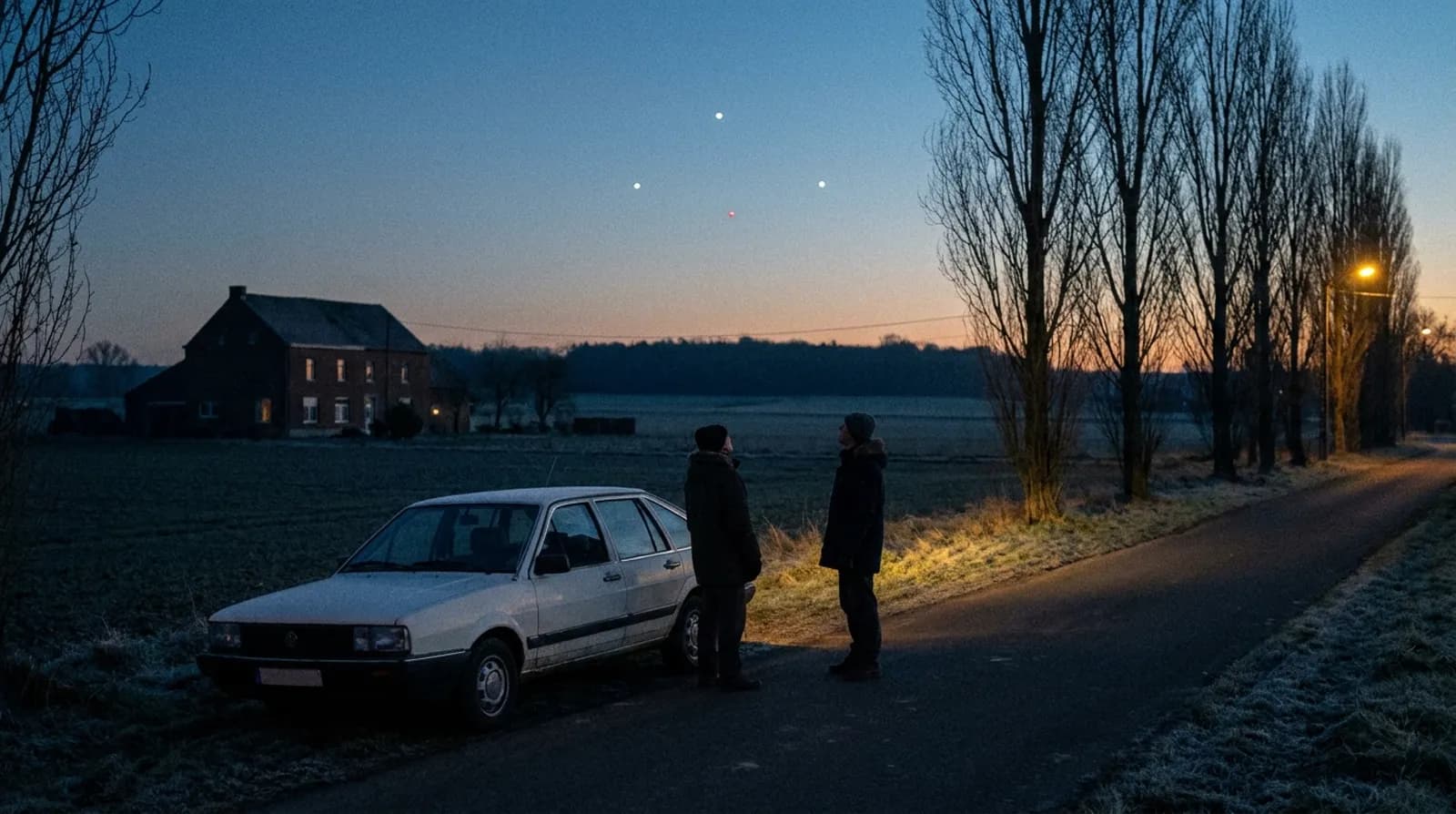
On the line is a gendarme named A. Renkin, calling from his home in Ramillies. He says he's looking at three unusual lights toward Thorembais-Gembloux. They're brighter than stars. They don't move. They sit at the points of an equilateral triangle, and their color keeps changing: red, green, yellow.
Ten minutes later he calls back. Three more lights are moving toward the first group. And this time, Glons has something on radar.
Within the hour, two F-16 fighters will be screaming over the Belgian countryside. We know all of this because the Belgian Air Force wrote it down, minute by minute, and let the public see it.
It started in Eupen
The wave's opening night was November 29, 1989, around Eupen, a German-speaking town in eastern Belgium near the German border.
Two gendarmes on patrol, identified in SOBEPS records compiled by researcher Patrick Gross as Heinrich Nicoll and Hubert von Montigny, reported a large, low-flying triangular object with three lights at its corners. SOBEPS, the Belgian Society for the Study of Space Phenomena, ultimately logged 143 reports from that day alone, and Gross's case index puts the count for the Verviers–Eupen area at nearly 150.
Witnesses described lights on the corners of a dark triangle, some with a small red flashing light between them, according to individual reports Gross compiled.
Over the following months the reports kept coming, about 2,600 in all by SOBEPS's count, according to Wikipedia. Belgium had a nationwide UFO wave on its hands, in the middle of NATO's backyard, at the very end of the Cold War.
The Air Force did something unusual
Most militaries handle UFO reports by saying as little as possible. Belgium's didn't.
The official report on March 30–31, written by Maj. P. Lambrechts of the Air Staff, says that from December 1989 on, the Air Force had been receiving witness reports, mostly through the gendarmerie, but that its radars had never been able to confirm a sighting and fighters sent up had never found anything.
It also says the Air Staff had already ruled things out. The report states that the presence or testing of B-2 or F-117 stealth aircraft, remotely piloted vehicles, ultralights and AWACS planes in Belgian airspace "can be excluded." Then the Ministry of Defense agreed to back SOBEPS's investigation, and the Air Force began cooperating with the civilian group directly.
That's remarkable. A NATO air force sharing radar data with UFO researchers.
The night of the F-16s
Here's the sequence from Lambrechts's report, all local time.
- 23:10: Glons picks up an unidentified radar contact about 5 km north of Beauvechain air base, moving west at about 25 knots.
- 23:28: A gendarmerie patrol including Capt. Pinson arrives and confirms Renkin's lights. Pinson says the points are the size of a big star and constantly change color.
- 23:49–23:59: A second radar site, the traffic control center at Semmerzake, confirms a clear contact at the same position.
- 23:56: Glons orders the quick reaction alert fighters of the 1st Fighter Wing to scramble.
- 00:05: Two F-16s, call signs AL 17 and AL 23, take off.
Over the next 50 minutes, the report says, the jets made nine interception attempts. "In three cases, the pilots managed to lock on the target during a few seconds, which, each time, induced a drastic change in the comportment of the UFOs."
The first lock came at 00:13. The target was 6 nautical miles ahead at 9,000 feet. According to the report, its speed changed "within minimum time from 150 to 970 knots," while it dropped to 5,000 feet, climbed to 11,000, then fell to near ground level. The lock broke after a few seconds.
At 00:30, AL 17 got another contact moving at 740 knots. When the six-second lock broke, the report says, "the signal of a jamming appears on the scope."
Meanwhile, witnesses on the ground watched the F-16s make three passes. On the third, they said, the jets circled inside the big triangle of lights, the small triangle vanished, and the brightest point shot away, probably upward, flashing red.
"In no case," the report says flatly, "the pilots have had a visual contact with the UFOs." By about 1:30 a.m., witnesses said, the remaining lights dimmed and appeared to scatter in four directions.
What the Air Force concluded
Lambrechts's conclusions are the part people still argue about. Among them:
- For the first time, a radar contact had been observed "in correlation with different sensors of the Air Force," in the same area as the visual sightings.
- The speeds and altitude changes measured during the locks "exclude the hypothesis" that the targets were airplanes.
- Balloons, planets, optical illusions and holograms were each judged inconsistent with the data.
- Supersonic speeds were measured several times, yet no sonic boom was heard. "Here also, no explanation can be given."
And on the witnesses:
"The visual evidences, on which this report is partially based, come from gendarmes in duty, whose objectivity cannot be questioned."
The Air Staff's operations chief, then-Col. Wilfried De Brouwer, initially thought the Americans might be testing an experimental aircraft over Belgium, according to Wikipedia's account. U.S. authorities said no USAF stealth aircraft had been operating there.
The skeptics' case, stated fairly
The skeptical argument is strong, and you should hear it.
The radar. Brian Dunning of Skeptoid says the Belgian military ultimately reported three locks, not the nine SOBEPS claimed, and that all three were the F-16s locking on each other. Other contacts were attributed to Bragg scattering, an atmospheric effect that produces false "angel" echoes. A detailed technical analysis, which Dunning attributes to an officer cadet working with the Air Force's electronic warfare center, has never been released.
Even the report has a hole in it. Lambrechts noted that ground witnesses saw eight points of light, but radar only ever showed one contact at a time, though the lights were far enough apart for radar to separate. "No plausible explanation can be put forward," he wrote.
Eupen. Investigator Renaud Leclet concluded the first night was almost certainly a Bell UH-1 helicopter, and that much of the gendarmes' report concerned a stationary light that was probably Venus, according to Skeptoid. Dunning also notes the gendarmes reported a low noise, and that most of the 143 reports came in after more than a week of media appeals.
The photo. The wave's most famous image, an April 1990 photograph of a black triangle taken at Petit-Rechain, near Verviers, was a hoax. In July 2011, the photographer, Patrick Maréchal, told RTL-TVI he made it from painted styrofoam with lights in the corners, hung from a string, according to Belgian public broadcaster VRT. Belgian skeptic Wim van Utrecht had long argued it could be reproduced with a small model.
The gap
So here's the honest score.
The famous photo is fake. The first night may have been a helicopter. The F-16 radar locks may have been the jets painting each other. The thousands of reports were shaped, at least in part, by media attention.
But none of that explains why two separate ground radars at Glons and Semmerzake tracked a contact where gendarmes said lights were hovering, why the Air Force went to the trouble of ruling out its own allies' stealth jets, or why its official report, after listing every conventional explanation, concluded it couldn't offer one.
What we know, and what we don't
What we know
- Belgium experienced a wave of triangle sightings from late 1989 into 1990, with about 2,600 reports collected by SOBEPS.
- On March 30–31, 1990, ground radar tracked unknowns, two F-16s were scrambled, and pilots got brief locks without any visual contact, per the Air Force report.
- The best-known photo from the wave was a confessed hoax.
What we don't
- What, if anything, the ground radars at Glons and Semmerzake actually tracked.
- Whether the full technical analysis of the F-16 radar tapes supports the false-return explanation, since it hasn't been released.
- What the gendarmes and thousands of other witnesses saw on the nights radar saw nothing.
The real lesson from Belgium
Belgium is the counterexample to every "they'd never tell us" argument. An air force published its logbook, cooperated with civilians, and admitted what it couldn't explain. That openness also let skeptics dig in, and they found real problems.
Is that the model the U.S. should follow, even if it means the mystery shrinks? Or does publishing everything just hand both sides more to fight over? Tell us where you land.
Sources
- Report concerning the observation of UFOs in the night from March 30 to March 31, 1990 (full text, English translation) — Belgian Air Force, Maj. P. Lambrechts, 1990 (via UFO Evidence)
- The Belgian UFO Wave (Skeptoid #538) — Brian Dunning, Skeptoid, 2016
- Belgian UFO picture was really a forgery — VRT News, 2011
- Eupen, November 29, 1989: case index and witness reports — Patrick Gross, URECAT (from SOBEPS files)
- The Belgium flap: the official position — Patrick Gross, URECAT
- Belgian UFO wave — Wikipedia (report counts, De Brouwer and U.S. responses)
End of file · VUF-2610-9730
Indexed under
- #belgium
- #belgian-ufo-wave
- #black-triangle
- #f-16
- #radar
- #1990
- #nato
Filed by · VUF-2610-9730
ViralUFOs Admin
ViralUFOs Editorial · Field Desk
The ViralUFOs editorial team investigates UFO reports, ufology research, and UAP news with an evidence-first commitment — separating documented fact from hypothesis.
About the deskField Gear · The Depot
Gear for the field
- FG-01
- FG-02
- FG-03
- FG-04





01Related files
 Modern EncountersVUF-2610-EBA6JAL Flight 1628: The 747 Captain Who Said a 'Mother Ship' Shadowed Him Over AlaskaOn November 17, 1986, a Japan Air Lines cargo 747 crew reported lights pacing their jet across Alaska. Controllers saw a blip. The FAA investigated, then blamed a radar glitch. The paperwork it released tells a stranger story.Oct 15, 2026 · 7 min read
 Modern EncountersVUF-2610-0B3EAriel School, 1994: Sixty-Two Children, One Field, and the Story They Still TellDuring a morning break in 1994, dozens of schoolchildren in Zimbabwe said something landed beside their playground. A BBC reporter, a UFO researcher and a Harvard psychiatrist came to listen. Thirty years later, most of those witnesses, now adults, haven't changed their story.Oct 14, 2026 · 6 min read
 Modern EncountersVUF-2610-6B5ETravis Walton, 1975: Five Days Missing, Fifty Years of Doubt, and a Crew That SplitSeven loggers said a light in the Arizona woods struck their friend and he vanished. He came back five days later. Polygraphs, a manhunt, a Hollywood movie, and now, in 2026, a crew member calling it a hoax while Walton stands by every word.Oct 6, 2026 · 6 min read