"Where Is Everybody?" The Fermi Paradox, the Zoo Hypothesis and UFOs
At a 1950 lunch at Los Alamos, Enrico Fermi asked the question that still haunts astronomy. One answer says aliens are deliberately leaving us alone. Another says something kills civilizations off. Where do UFO reports fit?
Case file● Open
- Case no.
- VUF-2608-B52A
- Filed
- Updated
- Read time
- 6 min
- Format
- article
- Filed by
- ViralUFOs Admin
- Class.
- Unclassified // Public
Contents· 8 sections
Summer 1950. Los Alamos, New Mexico. Four physicists are walking to lunch.
Emil Konopinski, Edward Teller and Herbert York are with Enrico Fermi, the Nobel Prize-winning physicist. On the way, they talk about flying saucers and a New Yorker cartoon explaining why New York's public trash cans kept disappearing.
Then, over lunch, Fermi suddenly asks a question. Teller remembered it as three words: "Where is everybody?"
Seventy-six years later, nobody has a confirmed answer. And one of the boldest proposals says the silence is on purpose.
The lunch that launched a paradox
Most of what we know about that lunch comes from Eric Jones, a Los Alamos scientist who wrote to the surviving witnesses in the 1980s. His 1985 report, "Where Is Everybody?": An Account of Fermi's Question, pieced the scene together.
The witnesses didn't agree on the exact wording. Konopinski recalled "but where is everybody?" York remembered "Don't you ever wonder where everybody is?" Jones concluded the lunch "quite probably" happened in the summer of 1950.
Here's a twist most retellings skip. Fermi probably wasn't declaring that aliens don't exist. Astronomer Robert H. Gray argued in a 2015 Astrobiology paper that Fermi was questioning whether interstellar travel was feasible.
The hard-edged version came later. In 1975, astrophysicist Michael Hart argued in the Quarterly Journal of the Royal Astronomical Society that the absence of aliens on Earth implies they don't exist anywhere in the galaxy. If even one civilization could spread out, Hart reasoned, it should have done so long ago. That argument, not Fermi's quip, is what most people now call the Fermi paradox.
Ball's answer: we're in the zoo
In July 1973, John A. Ball, a scientist at MIT's Haystack Observatory, published a three-page paper in the planetary science journal Icarus. Its title was "The Zoo Hypothesis."
Ball started from an optimistic premise: life may be nearly everywhere. If so, the oldest, most advanced civilizations would dominate. And if we see nothing, Ball suggested, maybe that's their choice.
"...they are deliberately avoiding interaction and that they have set aside the area in which we live as a zoo."
Think of a wildlife sanctuary, where animals are allowed to develop with minimal human contact. Star Trek fans will recognize the logic of the Prime Directive.
Ball was candid about the idea's limits. He called it "pessimistic and psychologically unpleasant." And he noted that it can be disproven, by contact, but never confirmed by observation. If the zookeepers are good, we'd never see them.
The darker alternative: the Great Filter
In 1998, economist Robin Hanson of George Mason University offered a grimmer frame in an essay titled "The Great Filter - Are We Almost Past It?"
Hanson's logic runs like this. Going from dead chemistry to a civilization that spreads across the stars takes many steps. Since we don't see anyone out there, at least one step must be extraordinarily hard.
"...there is a 'Great Filter' along the path between simple dead stuff and explosive life."
The scary question is where the filter sits. If it's behind us, maybe life itself is rare and we're lucky. If it's ahead of us, something tends to stop civilizations like ours.
That's why Hanson wrote that evidence of extraterrestrials "is likely bad (though valuable) news." Every easy step we find elsewhere makes it likelier that the hard one is still in front of us.
The case against the zoo
The zoo hypothesis has a coordination problem. It requires every civilization in the galaxy to follow the same rule, for millions of years, with no exceptions.
Astrophysicist Duncan Forgan tested that with a model in the International Journal of Astrobiology in 2017. Under most of his assumptions, the galaxy splits into multiple "Galactic Cliques" rather than one unified club. A single enforced quarantine needed many civilizations, lifetimes of several millions of years, and new arrivals only a few million years apart.
Critics also note that a single dissident group could break the pact. Stephen Webb, among others, doubts a ban like that could hold for millions of years without one breach, judging by human history.
Still, the idea hasn't been dismissed. In a 2023 Nature Astronomy paper, Ian Crawford and Dirk Schulze-Makuch reviewed the proposed solutions and boiled the options down to two. Either technological civilizations are extremely rare or absent, or they're out there and keeping quiet. Their framing: "the zoo hypothesis or nothing." They argue that sustained exploration could tell the two apart "within the next half-century."
So where do UFOs fit?
This is where things get interesting for our readers. A UFO believer might say the zoo hypothesis predicts exactly what we see. Visitors who watch from a distance, show themselves only briefly, and never land on the White House lawn.
It's a tempting fit. But be careful about what counts as evidence.
First, Ball's own paper doesn't rely on UFO reports. Its zookeepers are defined by staying hidden. Sightings that are frequent, fuzzy and unconfirmable aren't predicted by the hypothesis so much as compatible with almost anything.
Second, the official record so far doesn't show visitors. In its 2024 historical review, the Pentagon's All-domain Anomaly Resolution Office said it found no evidence that any government investigation, academic research or official review panel had confirmed a UAP sighting as extraterrestrial technology.
Third, and most important: if UFOs were proven to be alien craft, the Fermi paradox would be solved, and the zoo would have a leak. Ball's hypothesis would be both vindicated and broken in the same moment.
So UFO reports don't currently test the zoo hypothesis. They're an open question sitting next to it.
What we know, and what we don't
What we know
- Fermi asked some version of "Where is everybody?" at a Los Alamos lunch, probably in the summer of 1950, per witness accounts collected by Eric Jones.
- John Ball proposed the zoo hypothesis in Icarus in 1973, and Robin Hanson framed the Great Filter in 1998.
- Modeling work suggests a galaxy-wide no-contact rule is hard to maintain, but the idea still appears in serious review papers.
What we don't
- Whether technological life is common, rare, or unique to Earth.
- Whether the Great Filter, if it exists, is behind us or ahead of us.
- Whether any UFO report reflects nonhuman technology. No official investigation has confirmed one.
The silence is data
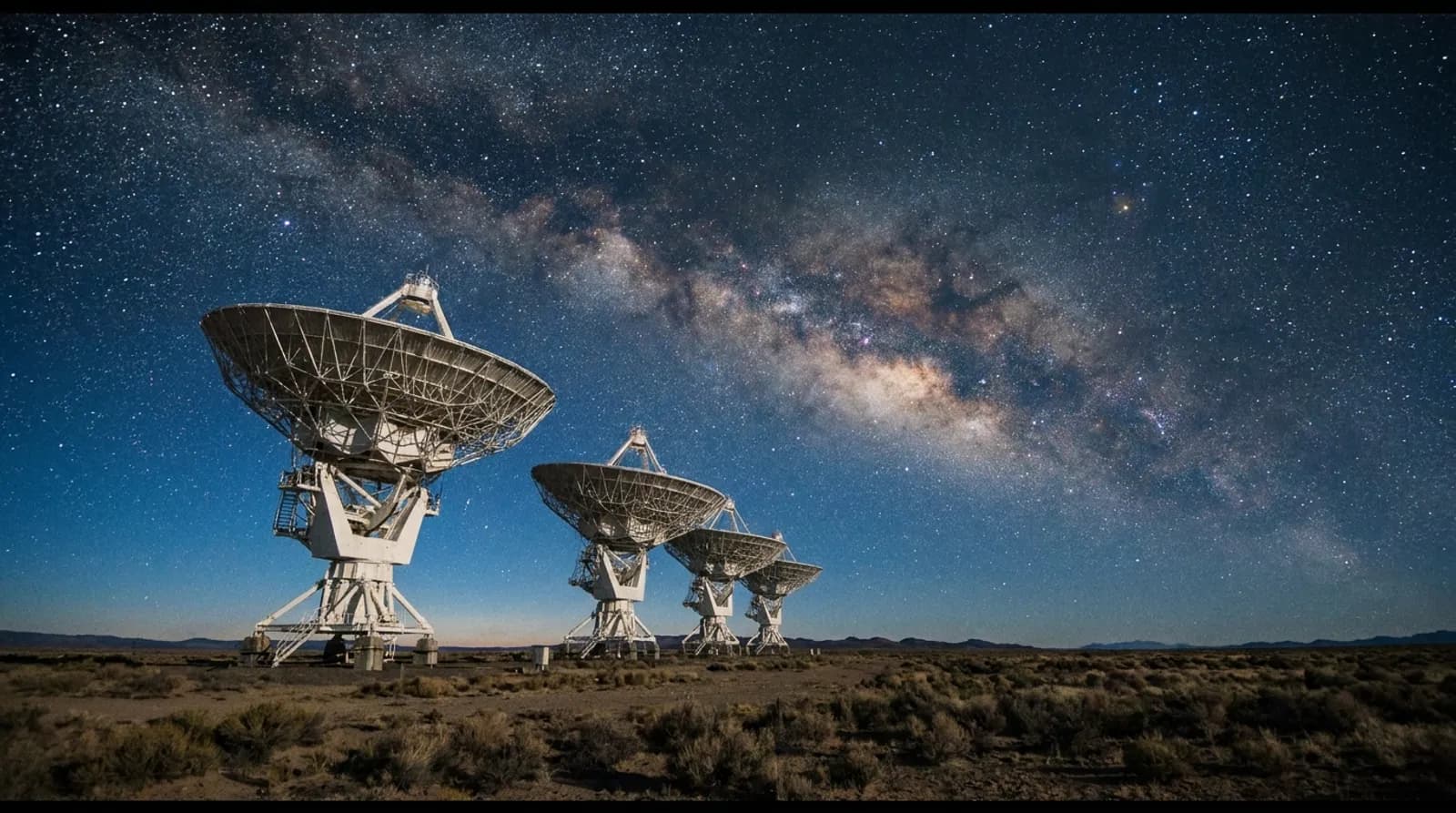
What would settle this? Any confirmed technosignature: a radio signal, an artificial object, an engineered atmosphere around a distant planet. One unambiguous detection ends the paradox.
And if decades of better telescopes keep turning up nothing, the zoo starts looking less like a sanctuary and more like an empty room.
So which answer do you find most convincing: we're alone, we're filtered, or we're being watched? Tell us in the comments.
Sources
- "Where Is Everybody?": An Account of Fermi's Question (LA-10311-MS) — Eric M. Jones, Los Alamos National Laboratory, 1985
- The Fermi Paradox is Neither Fermi's Nor a Paradox — Robert H. Gray, Astrobiology 15(3), 2015
- An Explanation for the Absence of Extraterrestrials on Earth — Michael H. Hart, Quarterly Journal of the Royal Astronomical Society 16, 1975
- The Zoo Hypothesis — John A. Ball, Icarus 19(3), 1973
- Beyond Fermi's Paradox VIII: What is the Zoo Hypothesis? — Universe Today
- Zoo hypothesis — Wikipedia
- The Great Filter - Are We Almost Past It? — Robin Hanson, George Mason University, 1998
- The Galactic Club or Galactic Cliques? Exploring the limits of interstellar hegemony and the Zoo Hypothesis — Duncan H. Forgan, International Journal of Astrobiology 16(4), 2017
- Is the apparent absence of extraterrestrial technological civilizations down to the zoo hypothesis or nothing? — Ian A. Crawford and Dirk Schulze-Makuch, Nature Astronomy, 2023 (via Astrobiology.com)
- Report on the Historical Record of U.S. Government Involvement with UAP, Volume I — All-domain Anomaly Resolution Office, 2024
End of file · VUF-2608-B52A
Indexed under
- #fermi-paradox
- #zoo-hypothesis
- #great-filter
- #seti
- #los-alamos
- #extraterrestrial-life
Filed by · VUF-2608-B52A
ViralUFOs Admin
ViralUFOs Editorial · Field Desk
The ViralUFOs editorial team investigates UFO reports, ufology research, and UAP news with an evidence-first commitment — separating documented fact from hypothesis.
About the deskField Gear · The Depot
Gear for the field
- FG-01
- FG-02
- FG-03
- FG-04








01Related files
 UFO TheoriesVUF-2610-B4E8Skinwalker Ranch: What's on the Record, and What's Made for TVA Utah ranch went from a 1996 newspaper story to a Pentagon contract to seven seasons of cable TV. Strip out the reenactments and the dramatic music, and the paper trail is stranger, and thinner, than you'd think.Oct 14, 2026 · 6 min read
 UFO TheoriesVUF-2610-187CAvi Loeb's Interstellar Probes: 'Oumuamua, the Ocean Spherules and 3I/ATLASA Harvard astrophysicist suggested a visitor from another star might be an alien light sail, then went to the bottom of the Pacific looking for a second one. Here's the strongest version of Avi Loeb's case, and why most astronomers aren't buying it.Oct 12, 2026 · 8 min read
 UFO TheoriesVUF-2610-0568The Saucer in Our Heads: The Psychosocial Theory of UFOs, Explained FairlyWhat if UFO reports follow the culture, not the sky? A school of European researchers, a famous 1947 newspaper phrase and a Harvard memory lab built the most serious skeptical framework in ufology. Here's what it explains well, and what it can't.Oct 6, 2026 · 7 min read