The Saucer in Our Heads: The Psychosocial Theory of UFOs, Explained Fairly
What if UFO reports follow the culture, not the sky? A school of European researchers, a famous 1947 newspaper phrase and a Harvard memory lab built the most serious skeptical framework in ufology. Here's what it explains well, and what it can't.
Case file● Open
- Case no.
- VUF-2610-0568
- Filed
- Updated
- Read time
- 7 min
- Format
- article
- Filed by
- ViralUFOs Admin
- Class.
- Unclassified // Public
Contents· 9 sections
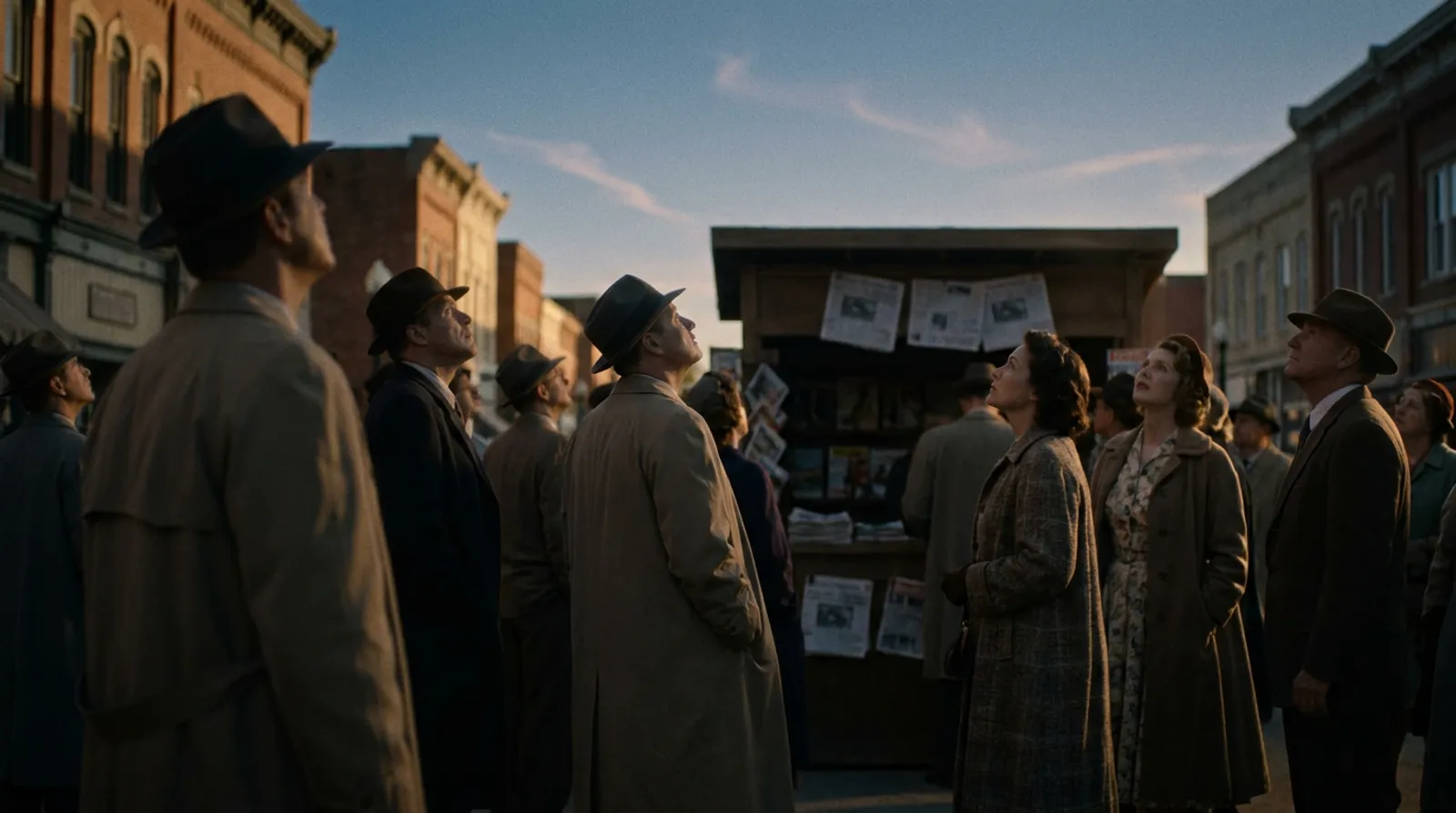
On June 24, 1947, a pilot named Kenneth Arnold landed in Pendleton, Oregon, with a story about nine shiny objects racing along the Cascades near Mount Rainier.
He told the editor of the East Oregonian, Nolan Skiff, that they moved in an undulating formation, "like a saucer would if you skipped it across the water." Within days, headlines across America were talking about mystery discs, and soon after, "flying saucers."
Here's the detail that launched a whole school of thought. Arnold's famous comparison described how the objects moved, not necessarily what they looked like, and at least one of them, by his account, was crescent-shaped. Yet within weeks, people everywhere were reporting saucers.
What if the shape came from the newspapers, not the sky?
Not debunking, a different question
First, a fair definition. The psychosocial hypothesis, often shortened to PSH, holds that at least some UFO reports are best explained by psychological or social factors. It's usually set against the extraterrestrial hypothesis.
Its advocates don't treat UFO witnesses as liars or fools. They treat UFO reports as a real human phenomenon worth studying, just not necessarily evidence of visiting craft. In their view, the interesting question isn't "what flew over?" but "why did people see it this way, at this moment?"
The European school
The idea took shape in France in the late 1970s.
Michel Monnerie, a French UFO researcher born in 1940, is regarded in some European circles as the pioneer of the psychosocial hypothesis. He sat on the editorial board of Lumières dans la Nuit, then one of France's most respected UFO magazines.
His books Et si les OVNIs n'existaient pas? ("What if UFOs Didn't Exist?", 1977) and Le naufrage des extra-terrestres (1979) challenged the extraterrestrial idea head-on. The magazine dropped him after the second one.
Monnerie's key observation was methodological. Reports that investigators eventually solved as ordinary objects contained the same narrative elements as unsolved ones, including engine failures and animals reacting. Nothing in a report reliably predicted whether it would turn out to be mundane.
His explanation: many high-strangeness experiences work like a "waking dream," sometimes triggered by a real stimulus, built out of mental images that matter to the witness and shaped by the dominant myth of the day.
Others carried the idea forward. French sociologist Bertrand Méheust traced parallels between early science fiction and UFO reports in Science-fiction et soucoupes volantes (1978). In Britain, the magazine Magonia, whose editors included Peter Rogerson and John Rimmer, became the home of the idea; a 1984 piece by Rogerson and Jacques Scornaux popularized the English term "psycho-social hypothesis."
Sightings that track the culture
The heart of the PSH is a pattern: UFO reports seem to change with the times.
The saucer itself. Researcher Martin Kottmeyer argued that the saucer shape came from a journalistic error in reporting Arnold's sighting, mixing up a description of motion with a description of shape. According to HistoryLink's account, the 1947 reports came in by the hundreds and peaked on July 8. The CIA's own 1997 history notes that Arnold's report "was followed by a flood of additional sightings."
The alien face. In his 1990 essay "Entirely Unpredisposed," Kottmeyer pointed out that Barney Hill first described wraparound alien eyes under hypnosis on February 22, 1964. Twelve days earlier, The Outer Limits had aired "The Bellero Shield," featuring an alien with strikingly similar eyes. "Could it be by chance?" he asked.
Older folklore. Magonia magazine shares its name with Jacques Vallée's 1969 book Passport to Magonia, which compared UFO encounters with fairy lore and older legends. Vallée drew a very different conclusion, but PSH researchers took the parallel as a sign that the human mind is the common thread.
Clancy's abduction lab
If the PSH has a modern flagship, it's the work of Harvard psychologist Susan Clancy.
In a 2002 study in the Journal of Abnormal Psychology, Clancy, Richard McNally, Daniel Schacter and colleagues compared people who reported recovered memories of alien abduction, people who believed they'd been abducted but had no memories of it, and a control group.
They used a standard lab test: memorize lists of related words, then recall them. The recovered-memory group did fine on the real words. But they were much more likely to "remember" a related word that had never been on the list.
The researchers' reading: people prone to false memories in the lab may also be more prone to building false memories of suggested or imagined experiences.
There was a second finding. According to the Harvard Gazette, everyone in the recovered-memory group came to believe in their abduction after describing an episode consistent with sleep paralysis, waking from REM sleep still unable to move. It affects about 15 percent of people, can be terrifying and can include buzzing, lights and shadowy figures by the bed.
"As far as science knows, nobody is being abducted by aliens."
Clancy expanded that work into the 2005 book Abducted: How People Come to Believe They Were Kidnapped by Aliens (Harvard University Press). She argues abductees are sane, intelligent people whose vivid memories come from things like sleep experiences, a widely shared cultural script and the search for meaning.
The best case against the PSH
Present the theory fairly, and you have to present its critics fairly too.
Instruments don't read newspapers. The PSH is at its best with eyewitness memory. It's weakest when sensors are involved. In its 2021 preliminary assessment of 144 military UAP reports, the Office of the Director of National Intelligence said 80 involved observation with multiple sensors. Culture can shape what a pilot remembers. It can't easily put a track on a radar screen.
The influence claims can be shaky. Kottmeyer's Outer Limits link has real problems. Betty Hill reportedly said she'd never heard of the show. Another episode with slanted-eyed aliens aired the following week. And Betty's earlier descriptions, written between 1961 and 1964, don't match the TV alien well.
Showing a bias isn't proving a memory false. Clancy's study shows that a group is more prone to memory errors, on average. It doesn't, by itself, show that any one person's abduction memory is false. That's a limit worth naming, not a refutation.
Pre-1947 reports. Extraterrestrial-hypothesis advocates point to saucer-like reports from before Arnold as evidence that the shape wasn't invented by the press. PSH researchers answer that those early accounts are largely unpublished and unreliable. The argument isn't settled.
What would settle it
The PSH makes predictions, and that's a strength. If it's right, reports should keep shifting with media trends, and well-instrumented cases should keep resolving into ordinary objects once the data is examined.
What would hurt it most is a case with clean, multi-sensor data showing something no known object could do, data that doesn't depend on anyone's memory. That's exactly the kind of data the U.S. intelligence community said in 2021 that it still lacked.
What we know, and what we don't
What we know
- Arnold described the 1947 objects' motion as saucer-like, and a flood of reports followed the national headlines.
- Michel Monnerie's 1977 and 1979 books launched the European psychosocial school.
- Clancy's 2002 study found people with recovered abduction memories were more prone to false recall in the lab.
What we don't
- How much of any individual report is perception, memory or something external.
- Whether the PSH can account for instrument-backed military cases.
- How strongly specific TV shows and films shaped specific witnesses.
The mirror and the sky
The psychosocial hypothesis is often treated as the "boring" answer. It isn't. It says the UFO is one of the great modern myths, a story humans keep telling ourselves in the language of whatever era we're in. That's a serious claim about us.
Its limit is equally serious. A myth can explain why people describe a saucer. It can't explain a radar return.
So where do you stand: is the psychosocial theory the key that unlocks most UFO reports, or a smart way of avoiding the hardest ones?
Sources
- Flying Saucers in Washington — Walt Crowley, HistoryLink.org, 1999
- Flying saucer — Wikipedia
- Psychosocial UFO hypothesis — Wikipedia
- Michel Monnerie — Wikipedia
- The Bellero Shield — Wikipedia
- CIA's Role in the Study of UFOs, 1947-90 — Gerald K. Haines, Studies in Intelligence, Central Intelligence Agency, 1997
- Starship memories — Beth Potier, Harvard Gazette, 2002
- Memory distortion in people reporting abduction by aliens — Clancy, McNally, Schacter, Lenzenweger and Pitman, Journal of Abnormal Psychology, 2002
- Abducted: How People Come to Believe They Were Kidnapped by Aliens — Susan A. Clancy, Harvard University Press, 2005
- Preliminary Assessment: Unidentified Aerial Phenomena — Office of the Director of National Intelligence, 2021
End of file · VUF-2610-0568
Indexed under
- #1947
- #abduction
- #folklore
- #psychosocial
- #skepticism
- #kenneth-arnold
- #susan-clancy
Filed by · VUF-2610-0568
ViralUFOs Admin
ViralUFOs Editorial · Field Desk
The ViralUFOs editorial team investigates UFO reports, ufology research, and UAP news with an evidence-first commitment — separating documented fact from hypothesis.
About the deskField Gear · From this file
Wear the evidence
- FG-01
- FG-02
- FG-03
- FG-04




01Related files
 UFO TheoriesVUF-2610-B4E8Skinwalker Ranch: What's on the Record, and What's Made for TVA Utah ranch went from a 1996 newspaper story to a Pentagon contract to seven seasons of cable TV. Strip out the reenactments and the dramatic music, and the paper trail is stranger, and thinner, than you'd think.Oct 14, 2026 · 6 min read
 UFO TheoriesVUF-2610-187CAvi Loeb's Interstellar Probes: 'Oumuamua, the Ocean Spherules and 3I/ATLASA Harvard astrophysicist suggested a visitor from another star might be an alien light sail, then went to the bottom of the Pacific looking for a second one. Here's the strongest version of Avi Loeb's case, and why most astronomers aren't buying it.Oct 12, 2026 · 8 min read
 UFO TheoriesVUF-2609-ED92Mirage Men: Did U.S. Intelligence Plant the UFO Myths to Hide Its Secrets?An Albuquerque physicist filmed lights over a nuclear storage site and ended up in a psychiatric unit. Air Force agents fed him alien stories. The FBI called MJ-12 'completely bogus.' How much of UFO lore was seeded on purpose?Sep 26, 2026 · 6 min read