Earthquake Lights and the Tectonic Strain Theory: Can the Ground Make UFOs?
Flames flickering over a street in L'Aquila. Blue flashes over Mexico. In 1977 two Canadian researchers proposed that stressed rock makes lights people call UFOs. Earthquake lights may be real. Whether they explain UFOs is another fight.
Case file● Open
- Case no.
- VUF-2609-85EA
- Filed
- Updated
- Read time
- 7 min
- Format
- article
- Filed by
- ViralUFOs Admin
- Class.
- Unclassified // Public
Contents· 8 sections
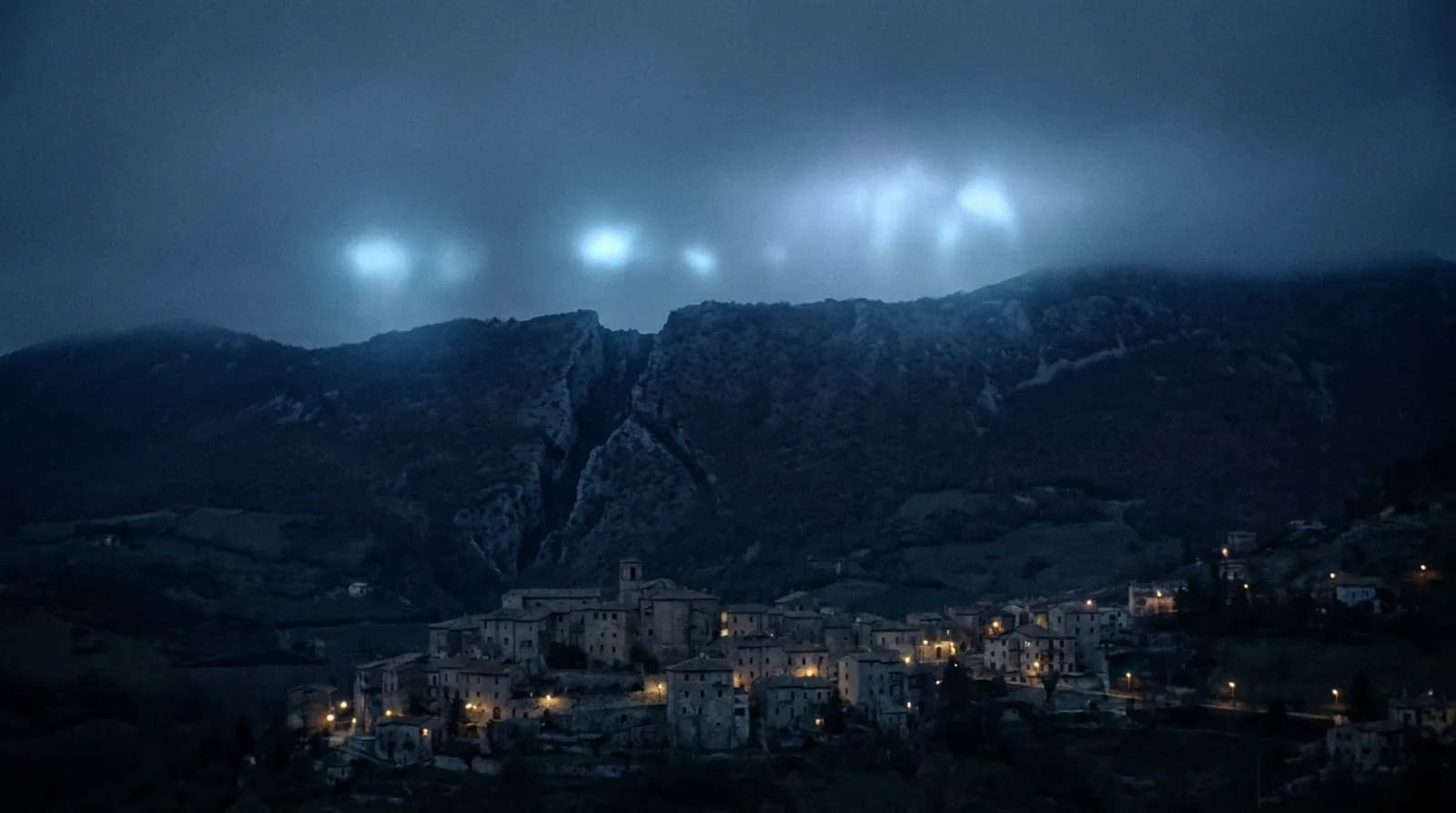
L'Aquila, central Italy, early April 2009. Before the ground split open, people say they saw fire where there shouldn't be any.
National Geographic later summed up one account: flames of light about four inches tall, flickering above a stone street. Then, on April 6, a deadly earthquake hit the city.
That image sits at the center of one of the strangest crossover ideas in UFO research. What if some lights in the sky aren't coming from the sky at all? What if they're coming from the rocks underneath?
Two researchers, one bold book
In 1977, Chicago publisher Nelson-Hall released Space-Time Transients and Unusual Events. Its authors were Michael A. Persinger, a professor at Laurentian University in Canada, and Gyslaine F. Lafrenière.
The book searched catalogs of strange reports for patterns that didn't fit current science. One of its core propositions, quoted in a later critique: "Transient and unusual phenomena should occur in areas where tectonic stress is accumulating."
Persinger built on that with seismologist John S. Derr. Their tectonic strain theory predicted that luminous phenomena and related physical effects are produced by strain in the crust. In a 1985 reply to critics, Persinger argued that most well-documented UFO episodes refer to real geophysical phenomena generated by tectonic strain.
That's the steelman, and it's a good one. No aliens required, no hoaxers required. Just a real but poorly understood natural process, plus human witnesses trying to describe something they've never seen before.
The lights are (probably) real
The best support for the theory comes from earthquake lights themselves, which have been reported for centuries.
In 2014, Robert Thériault, Friedemann Freund, John Derr and colleagues published a survey in Seismological Research Letters. They examined 65 of the best-documented earthquake-light cases in the Americas and Europe since 1600.
The pattern surprised them. About 85 percent of the lights appeared on or near rifts, and 97 percent appeared next to subvertical faults, fractures running nearly straight down.
"The numbers are striking and unexpected."
The researchers suggested that in rift settings, those near-vertical faults allow stress-induced electrical currents to rush toward the surface. They also estimated the right conditions occur in less than 0.5 percent of earthquakes worldwide. That's rare enough to explain why most people never see one.
Freund's battery in the rock
Freund, a physicist long associated with NASA's Ames Research Center, offers the most developed mechanism.
His idea: certain rocks, especially basalt and gabbro, carry tiny defects in their crystals. Squeeze them hard enough and electric charges activate, "as if you switched on a battery in the Earth's crust," as Freund explained it to National Geographic. Enough charge reaching the surface could ionize the air and produce light.
What does that look like? Freund told National Geographic the lights take "many different shapes, forms, and colors." Reports include bluish flames, glowing orbs and flashes that resemble lightning.
At L'Aquila, Italian researcher Cristiano Fidani spent seven months collecting testimonies after the quake. His 2010 paper in Natural Hazards and Earth System Sciences reported luminous phenomena starting about nine months before the main shock and continuing until about five months after it. Sightings were spread as far as 50 kilometers north of the city, with flames mostly seen along the Aterno Valley.
Then the skeptics walk in
Here's the problem. Testimony collected after a disaster is hard to verify. And modern cities are full of things that light up when the ground shakes.
Take Mexico in September 2017. After a massive quake, videos showed flashes over Mexico City, and ScienceAlert reported that the lights were "thought to have been caused by the earthquake itself." Others weren't so sure. Mexico's El Universal reported a UNAM geophysics researcher suggesting the timing could coincide with storms, and pointed to video of exploding transformers.
The same debate replayed in September 2021, when blue flashes lit up the sky during a quake near Acapulco. USGS earthquake geologist Austin Elliott told NPR that most of what people saw were power flashes, from swinging wires hitting other lines, trees or buildings. If natural lights were present, he said, they would have been difficult to discern next to the grid. UNAM seismologist Victor Manuel Cruz Atienza, who accepts the phenomenon is real, still couldn't tie that night's light show to the quake, given the rainstorm.
The U.S. Geological Survey's own position is cautious. As quoted by National Geographic, the agency says some doubt any reports constitute solid evidence of earthquake lights.
The lab work is contested, too. A 2014 study by Robert Dahlgren and colleagues in the Bulletin of the Seismological Society of America found stress-stimulated currents in dry gabbro samples but not in brine-saturated ones. That matters, because real crust is often wet. Freund has publicly disputed the group's conclusions. Meanwhile, Rutgers physicist Troy Shinbrot's team found voltage spikes in plain shifting powders like flour, which National Geographic reported the researchers attributed to friction, not rock chemistry.
The UFO connection is the weakest link
Even if earthquake lights are real, the leap to UFOs is a separate claim. And that's where the tectonic strain theory takes its heaviest fire.
Manitoba researcher Chris Rutkowski tested it against his home province in a critique he wrote in 1983 and released in 1984. Manitoba, he noted, isn't seismically active. Only eight earthquakes had been recorded within 200 kilometers of its border in a century, yet the province produced plenty of UFO reports.
"There seems more evidence for a UFO-demographic relationship than a UFO-geologic one."
In other words, UFO reports seemed to track where people live, not where faults are. Rutkowski called the theory one "with minimal supportive evidence." Persinger answered in print that his statistical analyses showed systematic links between UFO reports and earthquake measures in several regions.
Even neutral summaries flag the gap. Persinger's Wikipedia biography notes that support for the theory was "primarily correlational." Persinger died in 2018. His separate "God helmet" experiments drew their own replication failures, according to the same biography.
What we know, and what we don't
What we know
- Persinger and Lafrenière proposed in 1977 that crustal strain generates unusual phenomena, including lights reported as UFOs.
- A 2014 survey of 65 well-documented earthquake-light cases found a strong association with rifts and subvertical faults.
- Many famous "earthquake light" videos, including Mexico's, have competing explanations such as power-line arcing and storms.
What we don't
- The physical mechanism behind earthquake lights. There's no consensus among seismologists.
- Whether Freund's stressed-rock currents survive in wet, real-world crust.
- Whether more than a small share of UFO reports have anything to do with tectonic strain.
A theory that could actually be tested
Here's what makes this idea worth taking seriously: it can be checked. Put cameras, magnetometers and spectrometers near active rift faults, record continuously, and wait. If lights show up before quakes, far from power lines, and with a measurable electrical signature, the geophysics wins a big one.
Whether that would also explain the glowing orb your uncle saw over a Manitoba wheat field is a different, harder question.
So what do you think: are some UFOs really the planet itself lighting up, or is that just a tidy explanation for something stranger? Tell us in the comments.
Sources
- Space-time transients and unusual events (catalog record) — Michael A. Persinger and Gyslaine F. Lafrenière, Nelson-Hall, 1977 (New York Public Library)
- Michael Persinger — Wikipedia
- The Tectonic Strain Theory of Geophysical Luminosities — Chris A. Rutkowski, 1984 (reproduced online)
- Geophysical Variables and Behavior: A Response to Rutkowski's Critique of the Tectonic Strain Hypothesis (reference listing) — Michael A. Persinger, Perceptual and Motor Skills, 1985
- Prevalence of Earthquake Lights Associated with Rift Environments — Thériault, St-Laurent, Freund and Derr, Seismological Research Letters 85, 2014, doi:10.1785/0220130059
- Earthquake lights: a rift phenomenon — Science Learning Hub
- Earthquake lights — National Geographic
- The earthquake lights (EQL) of the 6 April 2009 Aquila earthquake, in Central Italy — Cristiano Fidani, Natural Hazards and Earth System Sciences 10, 2010, doi:10.5194/nhess-10-967-2010
- Strange earthquake lights accompanied Mexico's 8.2 magnitude earthquake — ScienceAlert, 2017
- Mysterious earthquake lights — El Universal, 2017
- First Came A Quake In Mexico, Then Strange Blue Lights. People Feared The Apocalypse — NPR, 2021
- Comparison of the stress-stimulated current of dry and fluid-saturated gabbro samples — Dahlgren et al., Bulletin of the Seismological Society of America 104, 2014, doi:10.1785/0120140144
- Shifting grains may explain earthquake lightning — Science News, 2014
End of file · VUF-2609-85EA
Indexed under
- #plasma
- #scientific-research
- #earthquake-lights
- #tectonic-strain-theory
- #italy
- #mexico
Filed by · VUF-2609-85EA
ViralUFOs Admin
ViralUFOs Editorial · Field Desk
The ViralUFOs editorial team investigates UFO reports, ufology research, and UAP news with an evidence-first commitment — separating documented fact from hypothesis.
About the deskField Gear · The Depot
Gear for the field
- FG-01
- FG-02
- FG-03
- FG-04







01Related files
 UFO TheoriesVUF-2610-B4E8Skinwalker Ranch: What's on the Record, and What's Made for TVA Utah ranch went from a 1996 newspaper story to a Pentagon contract to seven seasons of cable TV. Strip out the reenactments and the dramatic music, and the paper trail is stranger, and thinner, than you'd think.Oct 14, 2026 · 6 min read
 UFO TheoriesVUF-2610-187CAvi Loeb's Interstellar Probes: 'Oumuamua, the Ocean Spherules and 3I/ATLASA Harvard astrophysicist suggested a visitor from another star might be an alien light sail, then went to the bottom of the Pacific looking for a second one. Here's the strongest version of Avi Loeb's case, and why most astronomers aren't buying it.Oct 12, 2026 · 8 min read
 UFO TheoriesVUF-2610-0568The Saucer in Our Heads: The Psychosocial Theory of UFOs, Explained FairlyWhat if UFO reports follow the culture, not the sky? A school of European researchers, a famous 1947 newspaper phrase and a Harvard memory lab built the most serious skeptical framework in ufology. Here's what it explains well, and what it can't.Oct 6, 2026 · 7 min read