Chariots of the Gods? The Ancient Astronaut Theory Meets the Evidence
In 1968 a Swiss hotel manager asked whether the gods of antiquity were really astronauts. Nearly 70 million books and 22 TV seasons later, here's what Nazca, Palenque and Puma Punku actually show when archaeologists dig in.
Case file● Open
- Case no.
- VUF-2608-1F82
- Filed
- Updated
- Read time
- 7 min
- Format
- article
- Filed by
- ViralUFOs Admin
- Class.
- Unclassified // Public
Contents· 9 sections
March 1968. A small West German publisher, Econ Verlag, puts out a book called Erinnerungen an die Zukunft, "Memories of the Future."
Its author is Erich von Däniken, a Swiss hotel manager with no training in archaeology. His question is simple and electric. What if the gods of the ancient world were flesh-and-blood visitors from another planet?
In English it became Chariots of the Gods?, and it changed pop culture. When von Däniken died in January 2026, at 90, the Associated Press reported that his books had sold almost 70 million copies in more than 30 languages.
So it's fair to ask: after nearly six decades, how does the ancient astronaut theory hold up?
The pitch that hooked a generation
Give the theory its due. The appeal is real.
Ancient people really did build staggering things. Giant figures etched into the Peruvian desert. A Maya king's tomb sealed under a pyramid. Precisely cut stone blocks high on the Bolivian Altiplano.
Von Däniken's move was to treat every one of those achievements as a puzzle with one answer. Myths about gods descending from the sky? Eyewitness reports. Art that looks, to modern eyes, like a helmet or a machine? A snapshot of alien technology.
It's a thrilling story. It turns history into a detective novel, and it flatters the reader. You're seeing what the "establishment" missed.
The idea wasn't entirely new, either. French writer Robert Charroux had made similar claims, and his publisher contacted Econ Verlag in March 1968 about evidence of plagiarism. Later printings added Charroux to the bibliography. Both men likely drew on Louis Pauwels and Jacques Bergier's 1960 The Morning of the Magicians.
From paperback to prime time
The book exploded in the United States after a 1973 NBC documentary hosted by Rod Serling.
Three years later came the theory's second great author. Zecharia Sitchin's The 12th Planet (1976) claimed that Sumerian texts describe Nibiru, a hidden planet on a roughly 3,600-year orbit. Its inhabitants, the Anunnaki, supposedly came to Earth about 450,000 years ago to mine gold and genetically engineered humans as laborers.
Sitchin's books sold millions. Specialists in the ancient Near East were not impressed. Historian Ronald H. Fritze called his reading of ancient words "tendentious and frequently strained." Scholar Michael S. Heiser documented what he saw as many inaccuracies in Sitchin's translations. And no telescope has found a planet like Nibiru.
Then came cable. History aired a two-hour Ancient Aliens special on March 8, 2009. The series that followed has run 22 seasons, with von Däniken an occasional on-screen presence. It has also drawn steady fire from archaeologists. Kenneth Feder, an archaeology professor at Central Connecticut State University, said he told the producers bluntly what he thought of the hypothesis, in terms we won't print here.
Case one: the Nazca lines
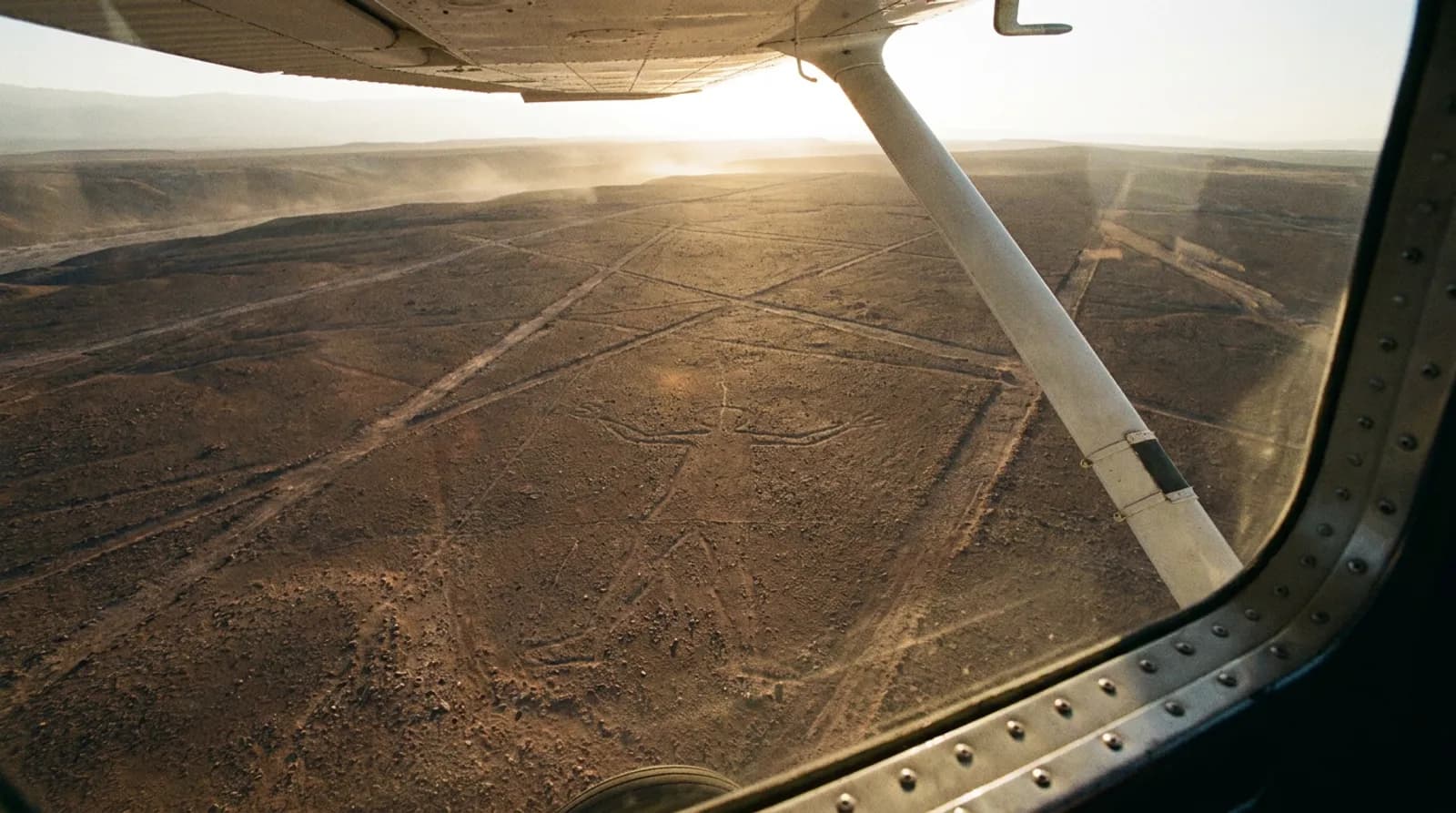
The Nazca lines are the theory's poster child. Von Däniken suggested that long straight lines on the Peruvian plateau looked like landing strips.
UNESCO, which lists the Lines and Geoglyphs of Nasca and Palpa as a World Heritage Site, dates them to between 500 B.C. and A.D. 500. They include animals, plants and huge geometric shapes. UNESCO notes they are believed to have had ritual astronomical functions.
Two problems sink the airport reading. First, one famous photo von Däniken used to suggest an airfield actually showed the knee joint of a bird figure. Second, you don't need a plane to make these figures.
In the early 1980s, investigator Joe Nickell reproduced the Nazca condor, about 440 feet long, on a Kentucky field. He used stakes, cord and a scale drawing, methods available to the Nazca. No aerial guidance needed, as Nickell reported in Skeptical Inquirer.
Case two: Pakal's "rocket"
In 1952, Mexican archaeologist Alberto Ruz Lhuillier finished clearing a hidden stairway inside the Temple of the Inscriptions at Palenque. At the bottom lay the tomb of K'inich Janaab' Pakal, a Maya king who ruled from 615 until his death in 683.
The carved sarcophagus lid shows Pakal reclining over what von Däniken read as a rocket's exhaust. He compared the king's posture to Mercury astronauts at the controls.
Maya specialists read it very differently. The central image is a cruciform world tree, a standard Maya motif. Pakal and a celestial serpent are framed by the open jaws of a funerary serpent, a common sign of entering the realm of the dead. The king also wears attributes of the Maize God, suggesting rebirth.
The same imagery appears on other panels at Palenque. Archaeologists, epigraphers and art historians have almost universally rejected the spaceship reading. Their core complaint: it relies on what the carving looks like to us, while ignoring the Maya writing and art that explain it.
Case three: Puma Punku
Puma Punku, part of the Tiwanaku site in Bolivia, features andesite blocks with crisp interior angles and flat faces. On TV, that precision is presented as proof of lost or alien tools.
The archaeology here is genuinely interesting, and genuinely human. Radiocarbon dating by Alexei Vranich places the start of construction at about A.D. 536 to 600. Researchers have traced the red sandstone to a quarry roughly 10 kilometers away and the andesite to the Copacabana Peninsula, about 90 kilometers across Lake Titicaca.
Here's the honest part. Researchers Jean-Pierre Protzen and Stella Nair noted that exactly how some of the sharpest cuts were made remains unknown. That's a real gap in the record.
But a gap is not a spaceship. In a 2018 Heritage Science paper, Vranich rebuilt the site's scattered blocks with 3D-printed models. He argues that local precursors at Pukara and Chiripa are "a solid piece of evidence" against extraterrestrial origins. The design, in other words, has a family tree in the Titicaca basin.
Where the evidence lands
Von Däniken never fully conceded. In his 1985 book New Memories of the Future, as the AP quoted him:
"I have admitted (my mistakes), but not one of the foundations of my theories has yet been brought down."
The record suggests otherwise. By 1978 he had admitted he'd never been inside the Cueva de los Tayos, a cave whose exploration he'd described. He had visited the man who made the "ancient" Ica stones of Peru and didn't mention it in his book. In 1991 he was the first winner of the Ig Nobel Prize for Literature.
There's a deeper criticism, too. The theory almost always picks non-European cultures and asks whether they could really have built their own monuments. Archaeologists have pointed out how that framing shortchanges the Maya, the Nazca and the Tiwanaku.
What we know, and what we don't
What we know
- Chariots of the Gods? (1968) launched the modern ancient astronaut movement. Sitchin's The 12th Planet (1976) and Ancient Aliens (from 2009) expanded it.
- The Nazca figures can be laid out with ground-level tools, and their dates and imagery fit Peruvian cultures.
- Pakal's lid uses standard Maya death-and-rebirth imagery, and Puma Punku's stones came from identifiable regional quarries.
What we don't
- Exactly which tools produced Puma Punku's sharpest interior cuts.
- The full ritual meaning of many Nazca lines.
- Whether any ancient artifact will ever turn up that can't be explained by the people who made it. So far, none has.
The real mystery is us
The ancient astronaut theory asks a good question and gives a bad answer. Yes, ancient monuments are astonishing. But every time archaeologists dig in, the trail leads back to human hands, human quarries and human gods.
What would change the verdict? One artifact. A material, an alloy or an inscription that can't be traced to its place and time. Six decades of searching haven't produced it.
So here's our question: does the ancient astronaut theory spark real curiosity about the past, or does it rob ancient people of credit for their own genius? Tell us in the comments.
Sources
- Erich von Däniken — Wikipedia
- Erich von Däniken, Swiss writer who spawned alien archaeology, dies at 90 — Associated Press via NBC News, 2026
- Robert Charroux — Wikipedia
- Zecharia Sitchin — Wikipedia
- Ancient Aliens — Wikipedia
- Lines and Geoglyphs of Nasca and Palpa — UNESCO World Heritage Centre
- The Nazca Lines Revisited: Creation of a Full-Sized Duplicate — Joe Nickell, Skeptical Inquirer, 1983 (republished)
- K'inich Janaab' Pakal — Wikipedia
- Pumapunku — Wikipedia
- Reconstructing ancient architecture at Tiwanaku, Bolivia: the potential and promise of 3D printing — Alexei Vranich, Heritage Science, 2018
- 3D-printed reconstructions provide clues to ancient site — Popular Archaeology, 2018
End of file · VUF-2608-1F82
Indexed under
- #history-channel
- #ancient-astronauts
- #von-daniken
- #nazca-lines
- #ancient-aliens
- #archaeology
Filed by · VUF-2608-1F82
ViralUFOs Admin
ViralUFOs Editorial · Field Desk
The ViralUFOs editorial team investigates UFO reports, ufology research, and UAP news with an evidence-first commitment — separating documented fact from hypothesis.
About the deskField Gear · The Depot
Gear for the field
- FG-01
- FG-02
- FG-03
- FG-04






01Related files
 UFO TheoriesVUF-2610-B4E8Skinwalker Ranch: What's on the Record, and What's Made for TVA Utah ranch went from a 1996 newspaper story to a Pentagon contract to seven seasons of cable TV. Strip out the reenactments and the dramatic music, and the paper trail is stranger, and thinner, than you'd think.Oct 14, 2026 · 6 min read
 UFO TheoriesVUF-2610-187CAvi Loeb's Interstellar Probes: 'Oumuamua, the Ocean Spherules and 3I/ATLASA Harvard astrophysicist suggested a visitor from another star might be an alien light sail, then went to the bottom of the Pacific looking for a second one. Here's the strongest version of Avi Loeb's case, and why most astronomers aren't buying it.Oct 12, 2026 · 8 min read
 UFO TheoriesVUF-2610-0568The Saucer in Our Heads: The Psychosocial Theory of UFOs, Explained FairlyWhat if UFO reports follow the culture, not the sky? A school of European researchers, a famous 1947 newspaper phrase and a Harvard memory lab built the most serious skeptical framework in ufology. Here's what it explains well, and what it can't.Oct 6, 2026 · 7 min read