Two Phantoms, One Light: The 1976 Tehran UFO the DIA Called a 'Classic'
In September 1976, Iran scrambled two F-4 Phantoms after a bright light over Tehran. One jet lost its instruments. The other tried to fire a missile and lost its weapons panel. A U.S. intelligence analyst called it 'an outstanding report.'
Case file● Open
- Case no.
- VUF-2609-C2BD
- Filed
- Updated
- Read time
- 7 min
- Format
- article
- Filed by
- ViralUFOs Admin
- Class.
- Unclassified // Public
Contents· 9 sections
Shortly after midnight on September 19, 1976, the phones started ringing at the Imperial Iranian Air Force command post in Tehran.
Residents of Shemiran, a neighborhood in the north of the city, were reporting a bright object in the sky. An air traffic controller at Mehrabad Airport looked for himself. So did a general, from his balcony. Then he authorized an intercept.
What happened over the next two hours ended up on a teletype to Washington, routed to the Defense Intelligence Agency, and, according to the message's address block, to offices including the White House, the CIA and the NSA.
A DIA analyst read it and wrote a line UFO researchers have quoted ever since.
The first Phantom turns back
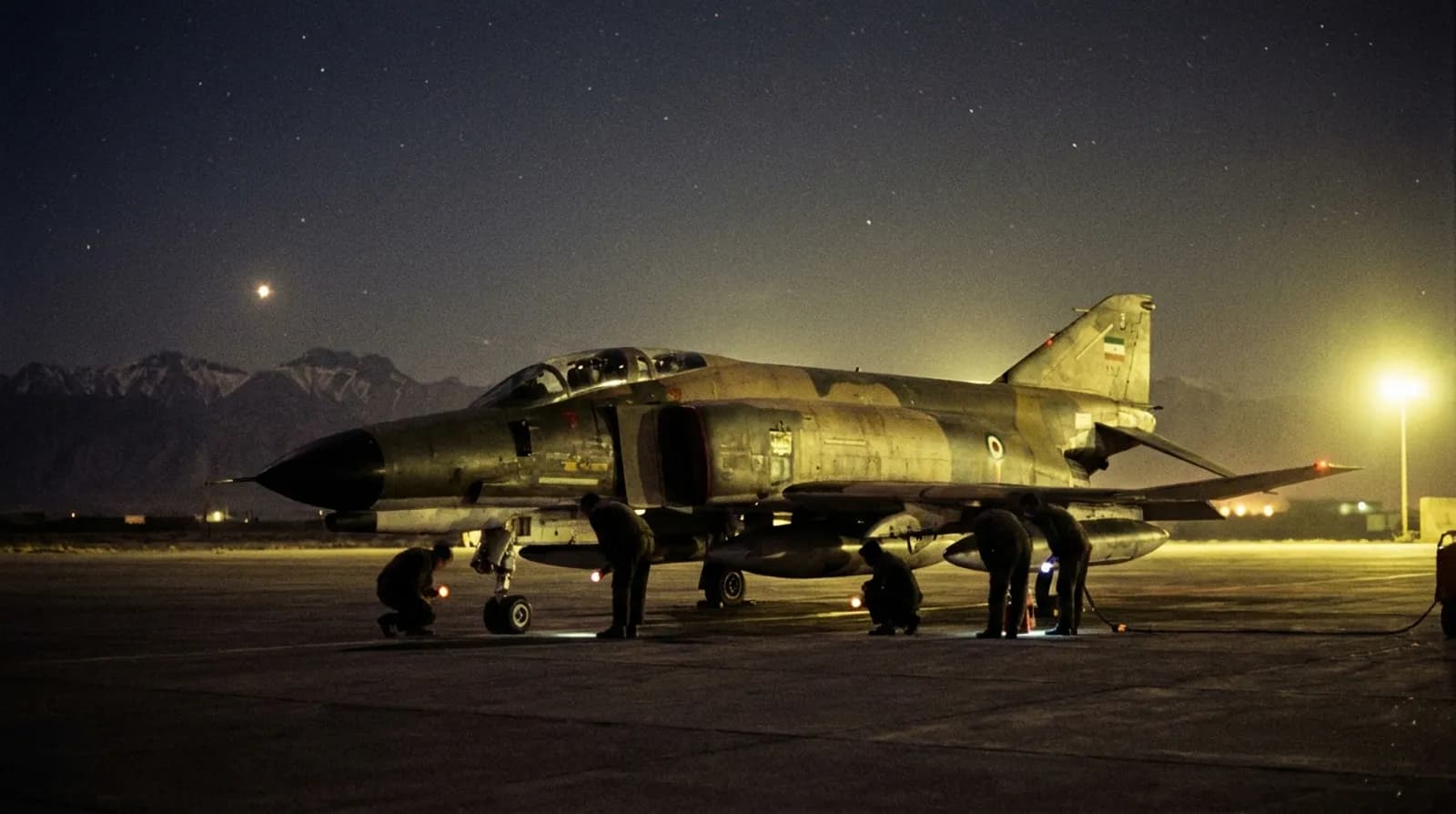
According to accounts built from the declassified U.S. record, the first F-4 launched from Shahrokhi Air Base, near Hamadan, at about 1:30 a.m. The pilot, identified in later accounts as Lt. Yadollah Nazeri, could see the object from a long way off. Wikipedia's summary of the record puts it at about 70 miles.
At about 25 nautical miles, the crew reported losing all instrumentation and UHF and intercom communications. They broke off. When they turned away, the instruments came back, according to the account compiled from the U.S. documents.
That's the first odd detail. The second jet is where it gets stranger.
The second Phantom gets a lock
About ten minutes later, a second F-4 launched. Its pilot was Maj. Parviz Jafari, a squadron commander. His weapons officer was 1st Lt. Jalal Damirian.
According to the U.S. account summarized in the declassified file, Jafari's crew got a radar lock at 27 nautical miles, with the target's return about the size of a 707 tanker. As they closed, the object seemed to pull away.
Then, the account says, a smaller bright object separated from the main light and came toward the jet at high speed. Jafari tried to fire an AIM-9 Sidewinder. At that moment, according to the record, his weapons control panel went dead and he lost UHF and intercom communications. He turned and dove to get away. The smaller object reportedly swung in behind him, then returned to the main light.
Jafari later described the main object as "flashing with intense red, green, orange and blue lights so bright that I was not able to see its body," in testimony quoted by Wikipedia from journalist Leslie Kean's 2010 book. He told the story publicly at a 2007 press event at the National Press Club in Washington.
The crews also reported seeing another bright object drop away from the main light toward the ground, according to the record. The next day, Jafari and Damirian flew out by helicopter to search the area. They found nothing. Wikipedia's summary of the file says a beeping signal was picked up nearby and that a family living close by reported a loud noise and a bright light the night before.
The line that made it famous
The U.S. defense attaché's report went into the system as a DIA Intelligence Information Report. Attached to it was a DIA evaluation form dated September 22, 1976, signed by Maj. Roland B. Evans, a military capability analyst, according to researcher Patrick Gross's transcription and The Black Vault's FOIA archive.
The form rated the information as "confirmed by other sources" and of "high" value, "unique, timely, and of major significance," according to The Black Vault. Then Evans added his remark:
"An outstanding report. This case is a classic which meets all the criteria necessary for a valid study of the UFO phenomenon."
He listed why: multiple witnesses, credible observers, visual sightings confirmed by radar, electromagnetic effects on three aircraft, physiological effects on crew, and what he described as an inordinate amount of maneuverability.
That's not a UFO buff talking. That's an evaluator inside a U.S. intelligence agency grading a report he was handed. To be fair, he was grading the report's quality and sourcing, not declaring the objects alien. But he wasn't shrugging, either.
The Air Force newsletter that retold it
In 1978, the case turned up again. Capt. Henry S. Shields wrote it up for a U.S. Air Force newsletter on meaconing, intrusion, jamming and interference, or MIJI, under the headline "Now you see it, now you don't!" The NSA later released it with its declassified UFO material.
Skeptic Brian Dunning argues that the Shields article is essentially a dramatized retelling of a memo by Lt. Col. Olin Mooy, the U.S. officer who attended a debriefing in Iran. Either way, it shows the case was circulating inside the U.S. military as a real interference event, not a joke.
The skeptics' case, stated fairly
The best-known skeptical breakdown came from aviation journalist Philip J. Klass in his 1983 book UFOs: The Public Deceived, later expanded by Dunning on Skeptoid.
The light. Klass proposed the initial bright light was probably Jupiter. James Oberg made the same suggestion. Dunning argues the jets weren't vectored straight at the light, and that the light appeared roughly where Jupiter would have been.
The "missiles." September 19 sits near the peaks of minor meteor showers, the Gamma Piscids and Southern Piscids, plus the tail of the Eta Draconids, Dunning notes. Fast, falling lights would not have been unusual. Tired crews at night, Klass argued, have made evasive maneuvers to dodge meteors before.
The electronics. Klass reported that technicians at Shahrokhi said only one of the jets reported electrical problems, and that jet had a history of them. Accounts of which jet that was differ. A McDonnell Douglas supervisor, as reported by Klass, suggested the weapons officer "could have been in manual track or something like that and not really realized it," which could produce a false lock.
The beeper. Dunning, citing Mooy's memo, says the beeping signal near the search area likely came from crash beacons on a U.S. C-141 transport, which had been shaken loose by turbulence over the mountains north of Tehran.
It's a tidy package. Planets, meteors and maintenance. Each piece is plausible on its own.
The gap
Here's the problem: the skeptical explanation needs every piece to land at once.
It needs a planet that a ground controller, a general, and two fighter crews all treated as worth an intercept. It needs a meteor to happen to come at a jet just as the pilot armed a missile. It needs a radar lock that was a false lock. And it needs electrical failures that, according to the U.S. account, struck as jets approached and cleared when they turned away. Even Dunning stops short of saying Jupiter explains every report from that night.
The DIA evaluator's list of reasons is, almost line for line, the list skeptics have to explain away. That's why both sides still fight over this one.
What we know, and what we don't
What we know
- Iran scrambled two F-4s after civilian reports of a bright light over Tehran on September 19, 1976, according to declassified U.S. records.
- A U.S. report on the incident went into DIA channels, and a DIA evaluator called it "an outstanding report" and "a classic."
- The case circulated inside the U.S. military, including in a 1978 Air Force MIJI newsletter.
What we don't
- What the main light actually was. Jupiter is the leading skeptical candidate; the crews' descriptions don't obviously fit a planet.
- Whether the equipment failures were caused by the object, by poor maintenance, or by crew error.
- What the U.S. did with the report after it was evaluated. The released file doesn't say.
The question that's still open
Forget aliens for a second. This is a case where a U.S. intelligence analyst, reading a report from a key Cold War ally, decided the sourcing was strong and the event was significant. Then the file went quiet.
If the explanation was Jupiter and a broken jet, why did a DIA analyst rate it "high value" and "unique"? And if it wasn't, what was flying over Tehran that night? Make your case in the comments.
Sources
- The 1976 Iran Incident: UFO Encounter Over Tehran, Iran (FOIA document archive) — The Black Vault
- DIA routing slip and summary of the 19 September 1976 Iran sighting (FOIA release) — National Security Agency
- "Now you see it, now you don't!" by Capt. Henry S. Shields, MIJI Quarterly — U.S. Air Force, 1978 (released by NSA)
- Tehran 1976: the DIA evaluation and U.S. teletype — Patrick Gross, URECAT case file
- The Tehran 1976 UFO — Brian Dunning, Skeptoid, 2012
- 1976 Tehran UFO incident — Wikipedia (summary of the record, Kean and Klass accounts)
- UFOs: The Public Deceived, by Philip J. Klass — Prometheus Books, 1983
Filed by · VUF-2609-C2BD
ViralUFOs Admin
ViralUFOs Editorial · Field Desk
The ViralUFOs editorial team investigates UFO reports, ufology research, and UAP news with an evidence-first commitment — separating documented fact from hypothesis.
About the deskField Gear · The Depot
Gear for the field
- FG-01
- FG-02
- FG-03
- FG-04






01Related files
 UAP ResearchVUF-2610-D772The Pentagon's New UFO Files: Everyone Saw the Black Triangle. Nobody Read Page Seven.Release 7 of the Pentagon UFO files put FBI agents and a silent black triangle on every front page. A few files down sits a 2008 DIA contractor plan written under the premise that non-human biological material had been recovered. Here's the full case file.Oct 28, 2026 · 12 min read
 UAP ResearchVUF-2610-2255The Pentagon's First UFO Chief Says He Saw Non-Human Beings. Here's the Full Case File.Jay Stratton ran the Pentagon's first UAP Task Force. Now his memoir says he saw non-human craft and beings with his own eyes, and the Pentagon's UFO office says there's no evidence. Here's every claim, the official record, and what would settle it.Oct 26, 2026 · 9 min read
 UAP ResearchVUF-2610-42F8The Hessdalen Lights: Norway's Valley Where Science Is Still Watching the SkyFor more than 40 years, balls of light have appeared over a remote Norwegian valley. Scientists brought radar, spectrometers and an automated station. They've recorded the lights. They still can't agree on what they are.Oct 15, 2026 · 8 min read