The Hessdalen Lights: Norway's Valley Where Science Is Still Watching the Sky
For more than 40 years, balls of light have appeared over a remote Norwegian valley. Scientists brought radar, spectrometers and an automated station. They've recorded the lights. They still can't agree on what they are.
Case file● Open
- Case no.
- VUF-2610-42F8
- Filed
- Updated
- Read time
- 8 min
- Format
- article
- Filed by
- ViralUFOs Admin
- Class.
- Unclassified // Public
Contents· 10 sections
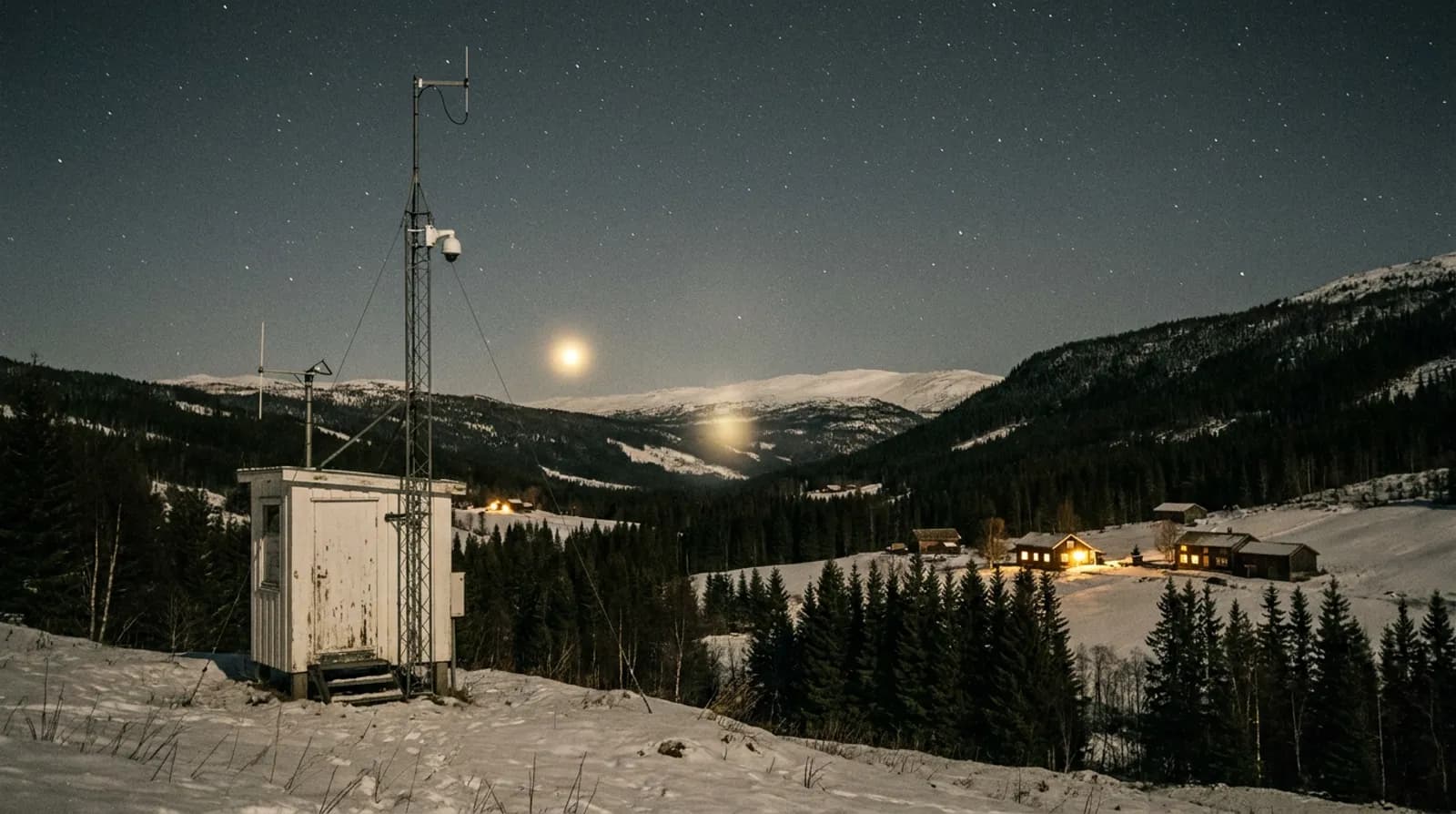
Winter, early 1980s. The Hessdalen valley in central Norway, a 12-kilometer strip of farms and spruce forest about 45 minutes north of Røros.
People start seeing lights. Not once. Constantly. White and yellow balls, hanging below the ridgelines, drifting, then racing off. Sometimes just above the rooftops.
At the peak, from December 1981 to mid-1984, residents were reporting 15 to 20 sightings a week. Tourists drove in to camp out and watch.
Most UFO stories end with a witness and a shrug. This one ended with scientists building a station on the hillside. It's still there.
A valley that wouldn't go dark
The Hessdalen lights come in a few flavors, according to engineer Erling Strand of Østfold University College, who has studied them since the start.
There are white or blue flashes, lasting at most two or three seconds, often a fraction of one. There are big yellow lights, up to about 10 meters across, that can hang still for minutes or wander the valley. Strand says some have been measured lasting up to two hours, bright enough to light the ground 20 meters below. And there are clusters, several lights moving together as if attached to one object, each blinking on and off on its own.
The flood of reports in the early '80s has slowed to something like 20 a year now, Strand wrote in a 2011 research summary. But they haven't stopped.
Project Hessdalen goes into the field
In June 1983, a small group of five, including Leif Havik, Odd-Gunnar Røed and Strand, set up Project Hessdalen, according to a history by physicist Matteo Leone. It grew out of the Norwegian and Swedish UFO organizations, and it secured technical support from the Norwegian Defence Research Establishment and the universities of Oslo and Bergen.
From January 21 to February 26, 1984, they ran a full field campaign in the snow. The gear list reads like a lab inventory: a spectrographic camera, a seismograph, radar, a spectrum analyzer, a magnetometer, a Geiger counter, a laser and an infrared viewer.
Here's what Strand reported from that five-week campaign:
- 53 lights of unknown origin.
- Radar returns, including when no light was visible.
- About 40 percent of sightings during a magnetic pulsation.
- No heat ever recorded, and no burn marks.
- Speeds, derived from radar, ranging from zero to 30,000 km/h.
That last number is the one that gets quoted on YouTube. Strand's own 1985 report was more careful. Lights above the ridgeline could be very far away, and without triangulation, distances couldn't be pinned down, as Leone points out in quoting it.
The machine on the hill
In 1993, the project restarted at what is now Østfold University College. And in August 1998, the college put up an automatic measurement station in the valley. Project Hessdalen calls it the Blue Box and bills it as the world's first automated anomaly detection system. It has recorded the lights on still images and video ever since.
Italian scientists followed. From 2000 to 2002, a team from Italy's National Research Council, code-named EMBLA, ran optical and radio missions with the Norwegians. Astrophysicist Massimo Teodorani summarized the work in a 2004 paper in the Journal of Scientific Exploration. As recently as 2014, the Research Council of Norway funded a small Norwegian-French cooperation, led by Østfold's Bjørn Gitle Hauge, to characterize the lights and test whether low-atmosphere plasma could explain them.
In a 2013 abstract for the European Geosciences Union, Strand and his Østfold colleague Bjørn Gitle Hauge listed what had been monitored: the Earth's magnetic field, multiple electromagnetic bands, radioactivity, ground resistance, ultrasound and seismic activity, plus radar, spectrometers and video.
Their bottom line was striking. "So far no electromagnetic radiation, except in the optical band, has been detected that can be coupled to the HP," they wrote. The lights shine, and as far as the instruments can tell, that's all they do.
"No exact birthplace has been located and the phenomenon seems to emerge 'out of thin air' anywhere in the valley."
The light that split in two
The most intriguing data point in that abstract comes from September 2006.
Hauge and Strand described a big white light, possibly no more than a few hundred meters above the ground, that divided into two balls. As it split, its brightness rose and it showed a continuous optical spectrum. Then the light dimmed, and the spectrum broke up into emission lines, "as if the phenomenon goes from a plasma to a gas state," they wrote. It ended as two dim, red balls, showing signs of a thermal process losing energy.
They also described lights seen on radar while invisible to the eye, and lights flying over the valley "apparently ignoring wind/weather conditions."
So what is it?
Scientists have proposed several natural mechanisms, published in real journals:
Dusty plasma. In 2010, researchers G. S. Paiva and C. A. Taft proposed in the Journal of Atmospheric and Solar-Terrestrial Physics that radon decay could ionize air and dust in the valley, forming ordered "Coulomb crystal" structures that glow. They argued it could explain the lights' oscillation, shape and spectrum.
Burning dust. In 2007, a spectral analysis by Hauge suggested combustion of airborne dust from the valley's old mines. Norwegian press declared the mystery solved. Consensus didn't follow.
A giant battery. Italian engineer Jader Monari proposed in 2014 that the valley works like a car battery. The western slope holds iron and zinc ore, the eastern slope copper, and the Hesja river, possibly acidified by an old mine, acts as electrolyte. Monari and a colleague placed stones on either side of the river and got enough current to light a bulb, according to the Norwegian science outlet forskning.no.
The skeptics' case, fairly stated
Not everyone is buying the exotic physics.
Norwegian physicist Bjørn Samset was blunt about the battery idea. "I don't think the phenomenon can be explained by such a battery. The distance is too great," he told forskning.no. On the "cold plasma" claims: "Cold plasma is a self-contradiction in my book, almost like hot ice."
Physicist Matteo Leone of the University of Bari went further on the EMBLA 2002 data. That report claimed a light emitting up to 100 kilowatts. Leone reanalyzed the photometry and spectra and concluded the measured light was consistent with a pair of car headlights on a road whose position matched the light's coordinates.
Skeptoid's Brian Dunning argues that many station images look like the landing lights of aircraft on the Oslo–Trondheim route, which passes near the valley, and that ground-level sightings should be checked against traffic on the valley road. That's how Texas' Marfa lights were largely explained.
These are real hits. Some Hessdalen lights are almost certainly cars, planes and stars.
The gap
But here's the thing: the researchers say so too. Leone, the toughest critic of EMBLA's numbers, still wrote that the anecdotal evidence from Hessdalen justified clearly defined scientific study. He didn't say the valley was empty.
Car headlights don't explain the radar returns the 1984 team logged. Airplanes don't split into two balls and shift from a continuous spectrum to emission lines. Aircraft lights don't explain a 1981–84 wave of 15 to 20 sightings a week that then faded away, while the airliners kept flying.
And nobody, skeptic or believer, has a model that the whole field accepts. After more than four decades of instruments in the snow, the honest scientific answer is still: we don't know.
What we know, and what we don't
What we know:
- Unexplained lights have been reported over Hessdalen since at least late 1981, peaking at 15 to 20 sightings a week.
- A 1984 instrumented campaign logged 53 unknown lights and radar returns.
- An automated station has watched the valley since 1998.
- Spectra show continuous emission in at least some events, and no confirmed non-optical radiation tied to the lights.
What we don't:
- What physical process produces the lights.
- Why activity peaked in the early 1980s and then dropped.
- How many recorded events are misidentified cars, aircraft or stars.
- Whether any single hypothesis, plasma, dust or battery, can explain all of it.
Still watching
Project Hessdalen is now a volunteer citizen-science organization, livestreaming cameras from the Blue Box and funded largely by members. In September 2026, it reported that, for the first time since a 2024 camera upgrade, a witness sighting, a so-called "Skipping Orb" seen on September 1, could be matched to a faint light on one of its cameras.
That's what makes Hessdalen different from almost every other case on this site. It isn't a story about one night. It's an open experiment, and anyone can watch.
So, natural plasma, burning mine dust, a valley-sized battery, or headlights and wishful thinking? Which explanation would you bet on?
Sources
- Project Hessdalen — Project Hessdalen, 2026
- The Hessdalen Phenomena (EGU 2011 poster, abstract XY484) — Erling Strand, Østfold University College, 2011
- Transformation and birth processes of the transient luminous phenomena in the low atmosphere of the Hessdalen valley, Norway — Bjørn Gitle Hauge and Erling Strand, Geophysical Research Abstracts, 2013
- A hypothetical dusty plasma mechanism of Hessdalen lights — Paiva and Taft, Journal of Atmospheric and Solar-Terrestrial Physics, 2010
- A Long-Term Scientific Survey of the Hessdalen Phenomenon — Massimo Teodorani, Journal of Scientific Exploration, 2004
- Eine Widerlegung des EMBLA 2002-Berichts (A rebuttal of the EMBLA 2002 report) — Matteo Leone, Zeitschrift für Anomalistik, 2006
- Little valley – a giant battery? — Arnfinn Christensen, forskning.no / ScienceNorway, 2014
- Unknown Luminous Phenomena in Hessdalen Valley (Norway), project 233863 — Research Council of Norway, 2014
- The Hessdalen Lights — Brian Dunning, Skeptoid, 2011
- Hessdalen lights — Wikipedia (summary of sighting history and hypotheses)
End of file · VUF-2610-42F8
Indexed under
- #hessdalen
- #norway
- #project-hessdalen
- #plasma
- #ball-lightning
- #scientific-research
Filed by · VUF-2610-42F8
ViralUFOs Admin
ViralUFOs Editorial · Field Desk
The ViralUFOs editorial team investigates UFO reports, ufology research, and UAP news with an evidence-first commitment — separating documented fact from hypothesis.
About the deskField Gear · The Depot
Gear for the field
- FG-01
- FG-02
- FG-03
- FG-04






01Related files
 UAP ResearchVUF-2610-D772The Pentagon's New UFO Files: Everyone Saw the Black Triangle. Nobody Read Page Seven.Release 7 of the Pentagon UFO files put FBI agents and a silent black triangle on every front page. A few files down sits a 2008 DIA contractor plan written under the premise that non-human biological material had been recovered. Here's the full case file.Oct 28, 2026 · 12 min read
 UAP ResearchVUF-2610-2255The Pentagon's First UFO Chief Says He Saw Non-Human Beings. Here's the Full Case File.Jay Stratton ran the Pentagon's first UAP Task Force. Now his memoir says he saw non-human craft and beings with his own eyes, and the Pentagon's UFO office says there's no evidence. Here's every claim, the official record, and what would settle it.Oct 26, 2026 · 9 min read
 UAP ResearchVUF-2610-CA10GIMBAL and GOFAST, Frame by Frame: What the Navy's 2015 UFO Videos ShowTwo grainy infrared clips from Navy Super Hornets, recorded in January 2015, helped push UFOs into Congress. The Pentagon says one is an ordinary object at 13,000 feet. The other is still being argued over, pixel by pixel.Oct 8, 2026 · 7 min read