GIMBAL and GOFAST, Frame by Frame: What the Navy's 2015 UFO Videos Show
Two grainy infrared clips from Navy Super Hornets, recorded in January 2015, helped push UFOs into Congress. The Pentagon says one is an ordinary object at 13,000 feet. The other is still being argued over, pixel by pixel.
Case file● Open
- Case no.
- VUF-2610-CA10
- Filed
- Updated
- Read time
- 7 min
- Format
- article
- Filed by
- ViralUFOs Admin
- Class.
- Unclassified // Public
Contents· 9 sections
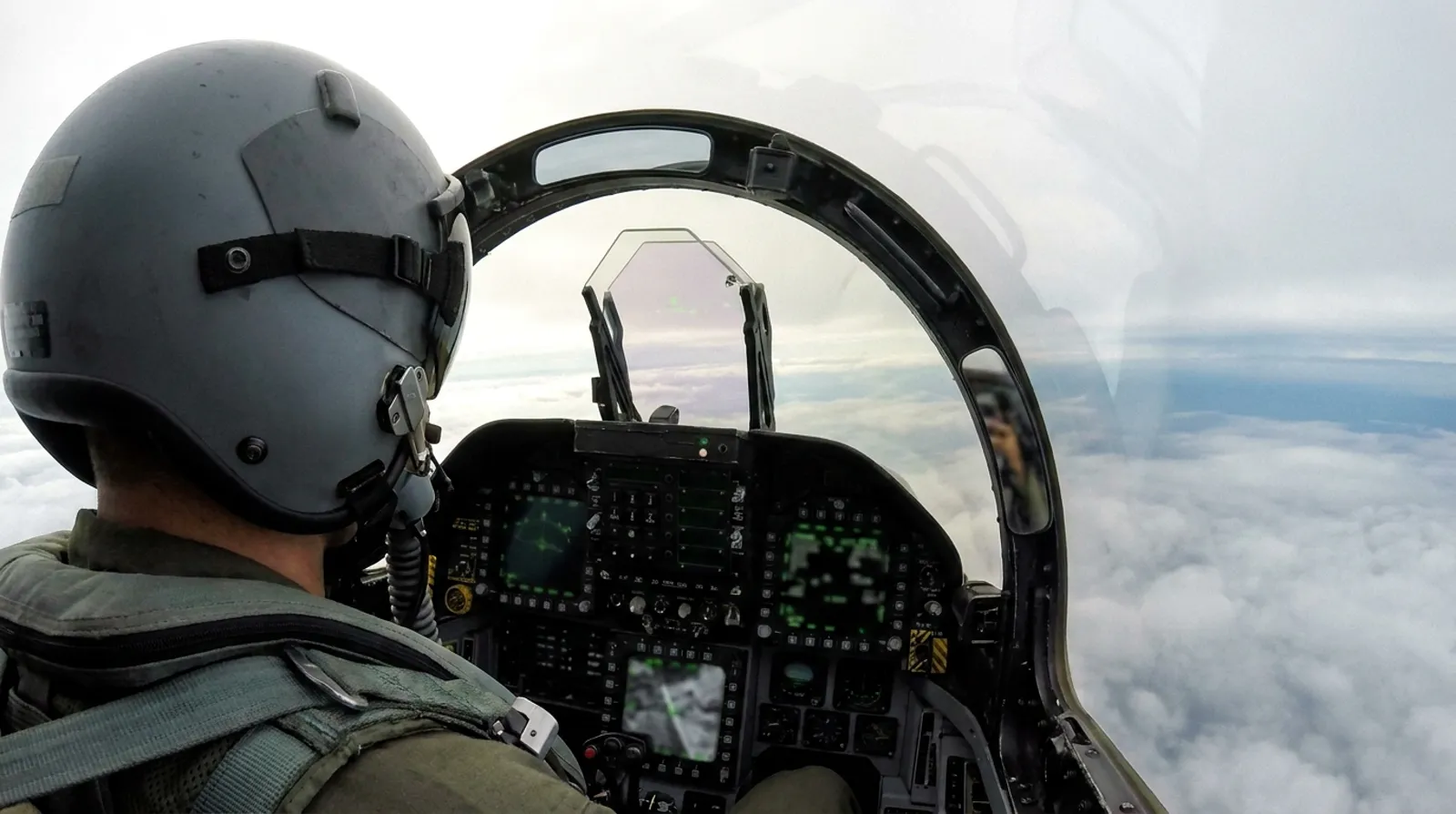
January 2015. Off the U.S. East Coast, Navy F/A-18 Super Hornets are flying training sorties. On a small cockpit display, an infrared targeting camera locks onto something.
On one clip, a dark, blurry shape with a glow around it drifts against the clouds, then appears to tilt on its side. A pilot's voice cuts in: "Look at that thing, it's rotating! My gosh!"
On another clip, a tiny white dot seems to skim the ocean at incredible speed while the crew reacts on the intercom.
These two videos, GIMBAL and GOFAST, changed how Washington talks about UFOs. And they're still being argued over, one frame at a time.
How two clips got out
The story went public on December 16, 2017, when The New York Times revealed a secret Pentagon program studying UFOs and published a Navy video showing an object with a glowing aura, rotating as it moved. "There's a whole fleet of them," one aviator says on the audio, according to the Times.
That was GIMBAL. GOFAST surfaced around the same time. Former Pentagon official Chris Mellon later told CBS's 60 Minutes that he leaked the videos to the Times.
In September 2019, the Navy stopped dodging. Spokesman Joseph Gradisher told NBC News that "the three videos (one from 2004 and two from 2015) show incursions into our military training ranges by unidentified aerial phenomena."
Then, on April 27, 2020, the Department of Defense made it official. It said it was releasing them "in order to clear up any misconceptions by the public" about whether the footage was real. Its conclusion: "The aerial phenomena observed in the videos remain characterized as 'unidentified.'"
Who was flying
NASA's later analysis says GOFAST was recorded by Navy aviators from the aircraft carrier USS Theodore Roosevelt.
Ryan Graves, a former Navy F/A-18 pilot, told 60 Minutes in 2021 that his squadron started seeing unidentified objects over restricted airspace southeast of Virginia Beach in 2014, after their jets got upgraded radar. How often? "Every day. Every day for at least a couple years," he said.
"These sightings are not rare or isolated; they are routine."
Asked by 60 Minutes about the 2015 video his squadron captured off Jacksonville, Florida, the one with the "it's rotating" audio, Graves said: "I don't know what it is, frankly."
GOFAST, frame by frame
Here's what you see. A black-and-white infrared view, looking down at the ocean. The camera struggles, then locks onto a small white object. The water streaks by underneath. The object looks like it's skimming the waves at tremendous speed.
But the screen also shows numbers. NASA's UAP independent study team, chaired by astrophysicist David Spergel, walked through them in its 2023 report: the camera's elevation angle, its azimuth, the target's range in nautical miles, the jet's altitude, a time reference, and indicated airspeed.
Run the trigonometry, NASA wrote, and the object is at an altitude of about 13,000 feet, with roughly 4.2 miles between it and the patch of ocean behind it in the frame. It is nowhere near the water.
The jet itself was moving at a groundspeed of about 435 mph and banking. That's what makes the ocean blur past. Over a 22-second stretch, NASA calculated that the object moved about 390 meters, an average speed of roughly 40 mph. "This is a typical wind speed at 13,000 feet," the report said. NASA also noted the object appeared colder than the ocean, meaning no visible heat from a propulsion system.
The Pentagon's All-domain Anomaly Resolution Office reached the same place. Director Jon Kosloski told a Senate Armed Services subcommittee on November 19, 2024: "we assess with high confidence that the object is not actually close to the water, but is rather closer to 13,000 feet." He blamed "a trick of the eye called 'parallax.'"
Boston University physicist Joshua Semeter, who served on the NASA panel, put the object's motion at around 30 to 40 mph, consistent with winds at that altitude.
GIMBAL, frame by frame
GIMBAL is harder.
On screen, a dark, elongated shape sits in the center of the frame with a bright halo around it. It appears to slide across a background of clouds. Toward the end, the shape seems to rotate, tipping from horizontal toward vertical, which is the moment the pilots react to.
The best-known skeptical analysis comes from Mick West of Metabunk. He argues the "object" is most likely the infrared glare of a distant jet. "I think what's clear about Gimbal is it's very hot, it's consistent with two jet engines next to each other," West told the San Diego Union-Tribune in 2021.
West's key point is the camera itself. The ATFLIR pod has to roll and rotate internally to keep tracking a target, and it uses a derotation mechanism to keep the image level. If the shape on screen is glare inside the optics rather than the object's true outline, the glare can appear to rotate when the pod rotates, even if the target doesn't. He also says the fast early motion is parallax: "At the start of the video, it looks like the object is moving rapidly to the left because of the parallax effect."
It's a detailed, testable argument. West has built simulations of the pod's geometry to make it.
The skeptics' case, fairly stated
Put it together and the skeptical case is strong. GOFAST has been analyzed by NASA and AARO, and both say the extraordinary speed is an illusion. A slow object at 13,000 feet, moving at wind speed, is consistent with a balloon or something similar.
GIMBAL's rotation can be explained by the camera, and its shape by glare. Neither video, on its own, shows physics-breaking performance.
The gap
But "not extraordinary" isn't the same as "identified."
NASA said so itself. "The availability of additional data would enable a more firm conclusion about the nature of this object," the report noted about GOFAST. Kosloski explained the speed. He didn't say what the object was. And the Pentagon still classifies all three videos as unidentified.
For GIMBAL, the pilots weren't just looking at an infrared screen. The voice on the tape says there's "a whole fleet of them," which suggests other contacts on their sensors that the public has never seen. Graves has described objects over the training ranges daily. The released clips are short excerpts, not the full sensor record.
The government has also described behavior that glare doesn't cover. The intelligence community's 2021 preliminary assessment said some UAP reports "appeared to remain stationary in winds aloft, move against the wind, maneuver abruptly, or move at considerable speed, without discernable means of propulsion." That's a general statement, not about GIMBAL specifically. But it's the official record, not a fan theory.
And we haven't found a public AARO analysis of GIMBAL comparable to its GOFAST work.
What we know, and what we don't
What we know:
- GIMBAL and GOFAST were recorded by Navy Super Hornet crews off the East Coast in January 2015.
- The Navy confirmed them in 2019, and the DoD officially released them in 2020, calling the phenomena "unidentified."
- NASA and AARO calculate that the GOFAST object was near 13,000 feet, moving at roughly wind speed.
- A detailed glare-and-camera-rotation explanation exists for GIMBAL.
What we don't:
- What the GOFAST object actually was.
- What the "fleet" on GIMBAL's audio refers to, and what other sensor data shows.
- Whether the Pentagon has analyzed GIMBAL in depth, and what it concluded.
- What the pilots saw before and after the released excerpts.
Two videos, two different verdicts
GOFAST is the closest thing UFO history has to a solved math problem, and the answer is "slow and high," not "fast and low." That's worth admitting. GIMBAL is still a live argument between a camera model and the people who were flying.
But the bigger story isn't either clip. It's that Navy pilots said they saw these things daily, and it took a newspaper leak to make anyone ask why.
Watch the videos yourself. Do you see glare and parallax, or something the numbers haven't explained yet?
Sources
- Statement by the Department of Defense on the Release of Historical Navy Videos — U.S. Department of Defense, 2020
- Navy FOIA document library (GIMBAL, GOFAST, FLIR videos) — Naval Air Systems Command
- Navy Officially Releases Infamous UFO Videos — The War Zone, 2020
- Navy confirms videos did capture UFO sightings — NBC News, 2019
- UAP Independent Study Team Final Report — NASA, 2023
- AARO findings on Go Fast and other cases — DefenseScoop, 2024
- 3 ways scientists use math to help debunk UFO videos — PBS NewsHour, 2025
- UFOs regularly spotted in restricted U.S. airspace — CBS News, 60 Minutes, 2021
- Congress dives into UFOs in a hearing featuring eyewitness testimony — TechCrunch, 2023
- Those Amazing Navy UFO Videos May Have Down-to-Earth Explanations, Skeptics Contend — San Diego Union-Tribune via AviationPros, 2021
- Gimbal Lock and Derotation in FLIR/ATFLIR systems — Mick West, Metabunk
- NYT: GIMBAL Video of U.S. Navy Jet Encounter with Unknown Object (quoting The New York Times, Dec. 16, 2017) — Metabunk
- Preliminary Assessment: Unidentified Aerial Phenomena — Office of the Director of National Intelligence, 2021
Filed by · VUF-2610-CA10
ViralUFOs Admin
ViralUFOs Editorial · Field Desk
The ViralUFOs editorial team investigates UFO reports, ufology research, and UAP news with an evidence-first commitment — separating documented fact from hypothesis.
About the deskField Gear · The Depot
Gear for the field
- FG-01
- FG-02
- FG-03
- FG-04







01Related files
 UAP ResearchVUF-2610-D772The Pentagon's New UFO Files: Everyone Saw the Black Triangle. Nobody Read Page Seven.Release 7 of the Pentagon UFO files put FBI agents and a silent black triangle on every front page. A few files down sits a 2008 DIA contractor plan written under the premise that non-human biological material had been recovered. Here's the full case file.Oct 28, 2026 · 12 min read
 UAP ResearchVUF-2610-2255The Pentagon's First UFO Chief Says He Saw Non-Human Beings. Here's the Full Case File.Jay Stratton ran the Pentagon's first UAP Task Force. Now his memoir says he saw non-human craft and beings with his own eyes, and the Pentagon's UFO office says there's no evidence. Here's every claim, the official record, and what would settle it.Oct 26, 2026 · 9 min read
 UAP ResearchVUF-2610-42F8The Hessdalen Lights: Norway's Valley Where Science Is Still Watching the SkyFor more than 40 years, balls of light have appeared over a remote Norwegian valley. Scientists brought radar, spectrometers and an automated station. They've recorded the lights. They still can't agree on what they are.Oct 15, 2026 · 8 min read