
Long before the congressional hearings, long before the leaked Navy videos, the United States government was already running a UFO investigation in the open. It lasted seventeen years, churned through more than twelve thousand cases, and ended with an official shrug. But buried inside that shrug is a number the debunkers would very much like you to forget.
12,618 reports investigated · 701 left "unidentified" · 1952–1969
A Program Born From Worry
Project Blue Book did not begin as a hobby. It grew out of the genuine alarm of the late 1940s, when unexplained objects were being tracked over American airspace — including over sensitive nuclear and military sites — and nobody could say whose they were. Building on the earlier Projects Sign and Grudge, the Air Force set out to answer two blunt questions: are UFOs a threat to national security, and are they real?
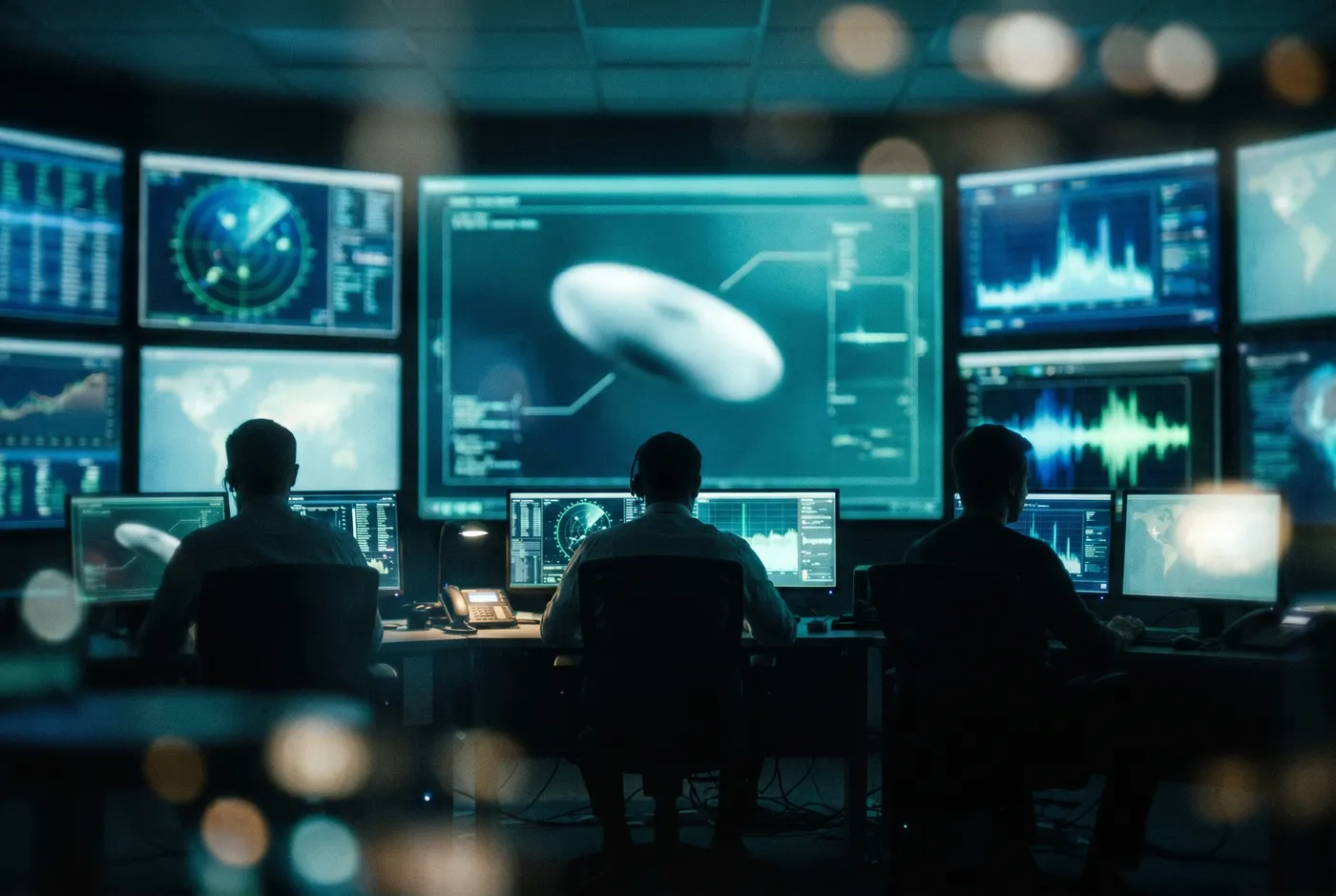
The machinery was methodical. Reports came in from pilots, police officers, radar operators, and ordinary citizens. Investigators interviewed witnesses, examined photographs, and worked to assign each sighting a conventional cause — aircraft, weather balloons, the planet Venus, temperature inversions. Most of the time, they could. That is honest, and it matters: the overwhelming majority of reports really do have everyday explanations.
The Skeptic Who Changed His Mind
The most important figure in this story is the man hired to explain the sightings away. Dr. J. Allen Hynek was an astronomer brought on as Blue Book's scientific consultant precisely because he was a skeptic. His job was to provide the prosaic answers — and at first, he did, with enthusiasm. He is the one who coined the dismissive phrase "swamp gas" for one infamous case.
But seventeen years of staring at the raw files did something to Hynek that no amount of public ridicule could undo. A residue of cases simply would not yield. Credible, sober witnesses describing the same impossible behaviors, again and again, with nothing to gain. By the end, the government's own hired skeptic had become its most respected proponent — the man who built the close-encounter classification scale that the entire field still uses. When the designated debunker walks away a believer, the data did that, not wishful thinking.
The Verdict and Its Asterisk
In 1968, the University of Colorado's Condon Report — the study that would justify shutting everything down — concluded that UFOs warranted no further scientific attention. Blue Book closed the following year. Case closed, the headlines said.
Except it wasn't. Of those 12,618 reports, 701 were formally classified as unidentified. Not "probably aircraft." Not "likely a balloon." Unidentified. The government's own investigators, working for nearly two decades with every tool available to them, examined those cases and could not explain them.
Critics have long argued that the Condon Report's conclusions did not even match its own contents — that the body of the study contained genuinely baffling cases that the summary quietly waved off. Whatever you make of that, the raw arithmetic survives: hundreds of officially unexplained encounters, sitting in a government archive, never accounted for.
The Cases That Made Even the Generals Nervous
Numbers are easy to dismiss in the abstract, so consider what some of those 701 actually looked like. In July 1952, over two consecutive weekends, unidentified objects were tracked on radar directly over Washington, D.C. — above the White House and the Capitol — by multiple radar stations at once, while pilots scrambled to intercept and reported lights right where the scopes said they would be. The "Washington flap" forced the largest Air Force press conference since the Second World War, and the official explanation, a temperature inversion, satisfied almost no one who had watched the blips maneuver.
It was not a fluke. There was the 1948 Chiles–Whitted case, in which two experienced airline pilots reported a wingless, glowing craft streaking past their airliner. There was the 1957 RB-47 incident, in which an Air Force reconnaissance plane was paced for over seven hundred miles by an object tracked simultaneously by the aircraft's own electronic sensors, by ground radar, and by the crew's eyes — the same multi-sensor confirmation that would make the Nimitz case famous half a century later. These were the files that turned a hired skeptic like Hynek into a believer. They are not blurry photographs. They are the documented experiences of military and commercial aircrews, preserved in the government's own archive, and never explained.
Why Blue Book Still Matters
Project Blue Book is often described as the program that "debunked" UFOs. That framing gets it backwards. Blue Book is the program in which the United States Air Force spent seventeen years trying its hardest to explain the phenomenon away — and admitted, in writing, that 701 times it could not.
The official narrative wants you to remember the closure and forget the count. The believers remember the count. Seven hundred and one unexplained cases is not a tidy ending; it is an open file the government chose to stop reading. The phenomenon did not close in 1969. Only the project did.
Written by
ViralUFOs Admin
The ViralUFOs editorial team investigates UFO reports, ufology research, and UAP news with an evidence-first commitment — separating documented fact from hypothesis.
More about us →More from this section
The Dispatch
Stay Informed.
Stay Curious.
The latest UAP news, fresh sightings, and evidence-first analysis — delivered to your inbox. No noise.
No spam. Unsubscribe anytime.