It's Official: The Pentagon Releases the Three Navy UFO Videos
For more than two years the world had watched three leaked Navy cockpit videos. On April 27, 2020, the Pentagon finally put its own name on them, and said the objects inside remain 'unidentified.'
Case file● Open
- Case no.
- VUF-2004-18E6
- Filed
- Updated
- Read time
- 6 min
- Format
- article
- Filed by
- ViralUFOs Admin
- Class.
- Unclassified // Public
Contents· 9 sections
On Monday, April 27, 2020, in the middle of a pandemic that had most of America locked indoors, the Department of Defense posted three short black-and-white videos to a Navy website.
Millions of people had already seen them. They had played on cable news, in The New York Times and on YouTube for more than two years. What was new was the label.
"The Department of Defense has authorized the release of three unclassified Navy videos," the Pentagon's statement began.
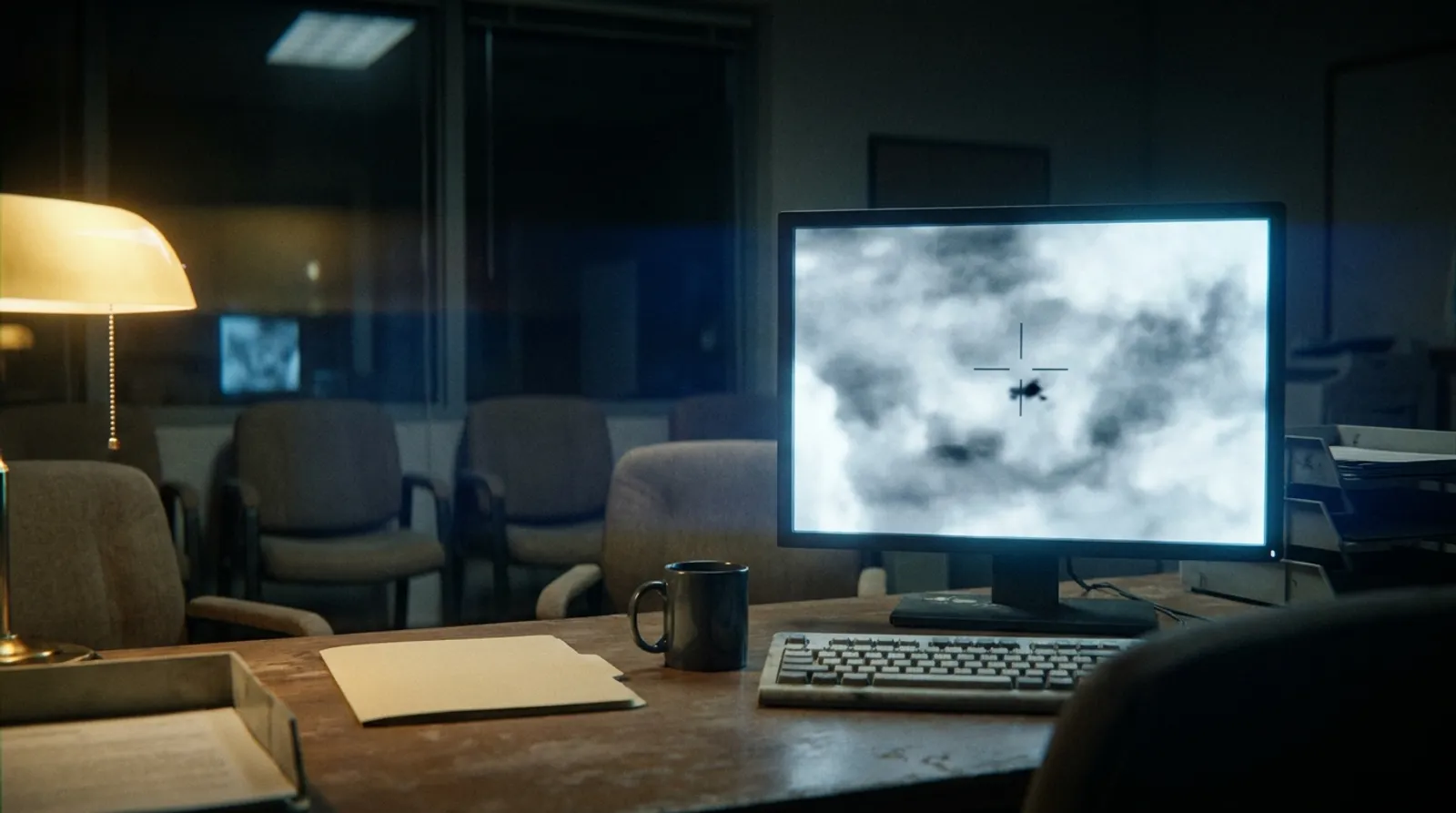
After years of leaks, denials and careful non-answers, the U.S. government officially owned the footage. And it said, in writing, that it still didn't know what was in it.
The statement, line by line
The release was brief. Here's what it said, according to the text republished by The War Zone and The Black Vault.
The three videos, it said, had been "circulating in the public domain after unauthorized releases in 2007 and 2017." One was recorded in November 2004. The other two were recorded in January 2015.
The Navy, it noted, "previously acknowledged that these videos circulating in the public domain were indeed Navy videos."
Then came the why. After a review, the department said, it had determined that "the authorized release of these unclassified videos does not reveal any sensitive capabilities or systems," and would not interfere with any later investigations of military airspace incursions.
"DOD is releasing the videos in order to clear up any misconceptions by the public on whether or not the footage that has been circulating was real."
The statement added that it also wanted to settle whether there was more to the videos. And then the line everyone quoted: "The aerial phenomena observed in the videos remain characterized as 'unidentified.'"
Pentagon spokesperson Sue Gough delivered the statement, CNN reported. The clips went up in the Naval Air Systems Command FOIA reading room, titled "FLIR," "GOFAST" and "GIMBAL."
Three videos, two incidents
A quick refresher, since we've covered the footage in depth elsewhere.
FLIR1, often called the "Tic Tac" video, came from the November 2004 encounters involving the USS Nimitz carrier group. Former Navy pilot David Fravor, who described seeing the object himself, told CNN in 2017: "As I got close to it ... it rapidly accelerated to the south, and disappeared in less than two seconds."
GIMBAL and GOFAST came from January 2015, recorded by Navy aircrews. Both show infrared targeting-pod footage with aircrew voices reacting in real time.
That's it for the frame-by-frame. The news here is less about what's in the videos than who was finally willing to sign for them.
The long road from leak to release
The release didn't come out of nowhere. It came after nearly two and a half years of official awkwardness.
Between December 2017 and March 2018, the videos were published by To The Stars Academy of Arts & Sciences, a company co-founded by musician Tom DeLonge, CNN reported. That was the same stretch in which The New York Times first revealed the Pentagon's Advanced Aerospace Threat Identification Program, according to Fox News.
Then the Pentagon spent two years declining to bless them. In early 2019, Gough said, "The videos were never officially released to the general public by the DoD and should still be withheld," according to The Black Vault.
In September 2019, the Navy confirmed the footage was authentic in response to questions from Black Vault founder John Greenewald. Navy spokesman Joseph Gradisher said, "The Navy designates the objects contained in these videos as unidentified aerial phenomena." He also stressed: "The Navy has not released the videos to the general public."
So for seven months the situation was strange. The Navy said the videos were real. The Navy said the objects were unidentified. And the Navy said, officially, that it hadn't released them.
April 27 closed that loop. Greenewald, who had been pursuing the videos through a Freedom of Information Act request, received the matching FOIA release letter the same day, The Black Vault reported.
The reaction: "only scratches the surface"
The loudest response came from the man who helped start it all.
Former Senate Majority Leader Harry Reid, who pushed for the Pentagon program launched in 2007, tweeted that he was "glad" the videos were out, but said "it only scratches the surface of research and materials available," according to CNN. He called for a serious, scientific look at the phenomena and any national security implications.
That phrase stuck because it pointed at the obvious question. If these three clips were safe to release, what else was sitting in the files?
Earlier in 2020, Vice's Motherboard had reported, based on a FOIA response, that the Navy held other UFO video it considered classified, The War Zone noted. The April release did nothing to change that.
What the release didn't do
It's worth being precise about the limits of this news.
The release didn't add a single new frame. The Black Vault noted the official versions offered nothing new visually beyond what the public had already seen.
It didn't explain the objects. "Unidentified" means exactly that. It's not a confirmation of anything exotic, and the Pentagon didn't suggest it was.
And it didn't settle the analysis. Skeptics have argued for years that at least some of the footage has ordinary explanations. Boston University physicist Joshua Semeter, who served on NASA's UAP study panel, later used the jet's speed, range and viewing angle to estimate the GOFAST object was moving around 30 to 40 mph. That, he said, "is consistent with the speed of the winds at the altitude of that object," PBS NewsHour reported.
What came next
The release turned out to be the start of a busy stretch.
Less than four months later, in August 2020, the Pentagon announced the Unidentified Aerial Phenomena Task Force, led by the Navy, to "improve its understanding of, and gain insight into, the nature and origins of UAPs." In June 2021, the intelligence community delivered its first public UAP assessment to Congress.
In May 2022, testifying at an open House Intelligence subcommittee hearing, Deputy Director of Naval Intelligence Scott Bray was asked to name a case that still couldn't be explained. He pointed to "the 2004 incident from Nimitz." "We have data on that," he said, "and that simply remains unresolved."
What we know, and what we don't
What we know
- The Pentagon officially released FLIR1, GIMBAL and GOFAST on April 27, 2020, and confirmed they were recorded in November 2004 and January 2015.
- It said the release revealed no sensitive capabilities and that the objects remain "unidentified."
- The Navy had acknowledged the videos as authentic in September 2019.
What we don't
- What the objects in the videos are. The Pentagon has never said.
- What other UAP footage the Navy holds and keeps classified.
- What, beyond these clips, Reid meant by the "research and materials available."
A small step with a long shadow
On paper, this was minor news. Three old videos, already viral, got an official stamp.
But official stamps matter. The government went from "should still be withheld" to "authorized the release" in about a year, and it did so while saying, plainly, that it couldn't identify what its own pilots filmed. That's not disclosure. It's the government admitting the question is open.
So here's ours: was the April 2020 release a genuine step toward transparency, or a way to close the book on three famous clips while keeping everything else locked up? Make your case in the comments.
Sources
- Navy officially releases UFO / UAP videos, calls them "historical" — The Black Vault, 2020
- Navy officially releases controversial UFO videos — The War Zone, 2020
- Statement by the Department of Defense on the Release of Historical Navy Videos — U.S. Department of Defense, 2020
- Pentagon officially releases UFO videos — CNN via KSAT, 2020
- US Navy drafting new guidelines for reporting UFOs — Fox News, 2019 (AATIP background)
- Establishment of Unidentified Aerial Phenomena Task Force — U.S. Navy / Department of Defense, 2020
- 3 ways scientists use math to help debunk UFO videos — PBS NewsHour, 2025
- Unidentified Aerial Phenomena: open hearing transcript — House Permanent Select Committee on Intelligence, 2022
End of file · VUF-2004-18E6
Indexed under
- #nimitz
- #pentagon
- #gimbal
- #gofast
- #us-navy
- #flir
- #foia
- #navy-videos
Filed by · VUF-2004-18E6
ViralUFOs Admin
ViralUFOs Editorial · Field Desk
The ViralUFOs editorial team investigates UFO reports, ufology research, and UAP news with an evidence-first commitment — separating documented fact from hypothesis.
About the deskField Gear · From this file
Wear the evidence
- FG-01
- FG-02
- FG-03
- FG-04



01Related files
 NewsVUF-2609-0350Under Oath: What David Grusch Actually Told Congress, and What Came NextCrash retrievals, 'nonhuman' biologics, secret budgets and reprisals. In July 2023 a former intelligence officer told Congress all of it under oath. Here is exactly what he said, what he didn't, and how the Pentagon answered.Sep 15, 2026 · 7 min read
 NewsvideoVUF-2606-3263Under Oath: The Day UFOs Reached the Halls of CongressDecorated officers and a former intelligence official sat before Congress, raised their right hands, and testified — under oath, on live television — about recovered craft and decades of secrecy. The subject is no longer fringe. It is federal.Jun 14, 2026 · 4 min read
 NewsVUF-2509-97A2A Hellfire, a 'Tic Tac' and Five Witnesses: Inside Luna's September 2025 UAP HearingOn September 9, 2025, Rep. Anna Paulina Luna's declassification task force put military UAP witnesses under oath, and a congressman played video of a Hellfire missile striking an orb off Yemen. Here's who said what, and what the Pentagon said back.Sep 10, 2025 · 6 min read