Two 'Bodies' in Glass Boxes: Mexico's Congress and the Nazca Specimens
On September 12, 2023, a Mexican journalist wheeled two small, three-fingered 'bodies' into Mexico's Congress and called them non-human. Scientists pushed back within days. Here's what was claimed, what was tested, and what Peru's forensic experts found.
Case file● Open
- Case no.
- VUF-2309-BE80
- Filed
- Updated
- Read time
- 6 min
- Format
- article
- Filed by
- ViralUFOs Admin
- Class.
- Unclassified // Public
Contents· 11 sections
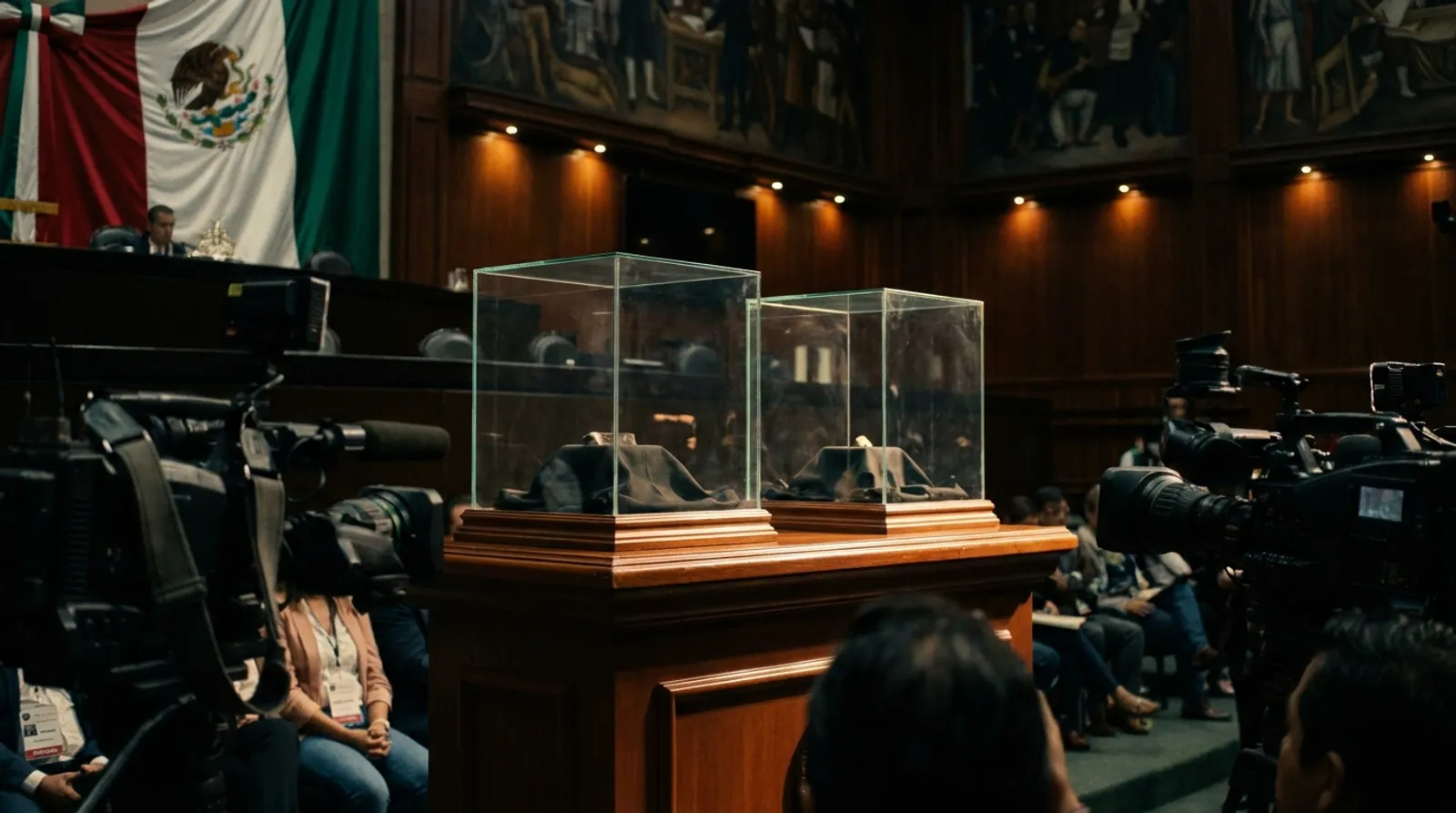
On Tuesday, September 12, 2023, inside the San Lázaro legislative palace in Mexico City, Mexico's Chamber of Deputies held its first hearing on unidentified anomalous phenomena.
Most of it was sober. A former U.S. Navy pilot talked about stigma. Lawmakers watched videos of Mexican pilots struggling to make sense of fast-moving objects.
Then journalist and longtime UFO promoter Jaime Maussan brought in two small boxes.
Inside each was a small figure with an elongated head and three long fingers on each hand. Speaking under oath, Maussan told lawmakers these were "non-human specimens that are not related to any other species."
What Maussan claimed
The claims came fast, according to Reuters and NPR.
Maussan said the bodies were found in Peru in 2017, near the famous Nazca Lines. He said they were roughly 1,000 years old, based on carbon dating by Mexico's National Autonomous University, UNAM.
"These are not mummies," he said, NPR reported. "These are complete bodies that have not been manipulated." He claimed one of them had been pregnant.
His conclusion was the line that went global. "We are not alone," he told lawmakers, Reuters reported.
A military doctor backs him up
Maussan wasn't the only one at the microphone.
José de Jesús Zalce Benítez, director of the Mexican Navy's Scientific Institute for Health, said X-rays, 3D reconstruction and DNA analysis had been carried out on the remains, according to Reuters.
"I can affirm that these bodies have no relation to human beings," he said.
He showed scans and claimed the beings had large brains and eyes and no teeth, so they likely drank rather than chewed, NPR reported.
The pilot in the room
The hearing had a second headliner.
Ryan Graves, the former U.S. Navy fighter pilot who had testified before a U.S. House subcommittee that July, spoke about his own UAP experience and the stigma around reporting sightings, Reuters reported. NPR noted he was then executive director of Americans for Safe Aerospace.
Graves didn't stay quiet about the bodies. The next day, he gave his verdict.
"I am deeply disappointed by this unsubstantiated stunt."
"Yesterday's demonstration was a huge step backwards for this issue," he added, according to Global News.
UNAM: "In no case"
Maussan's strongest-sounding evidence was UNAM's carbon dating. UNAM moved quickly to distance itself.
Two days after the hearing, the university republished a statement it first issued in 2017. It said the work by its National Laboratory of Mass Spectrometry with Accelerators was only meant to determine the age of the samples. "In no case do we make conclusions about the origin of said samples," UNAM said, Reuters reported.
Julieta Fierro, a researcher at UNAM's Institute of Astronomy, was blunter. She said the calcified bodies "made no sense" and disputed that her university had endorsed the find, according to Global News.
Fierro reviewed the test results Maussan shared at Reuters' request. She said the carbon-14 data pointed to brain and skin tissue from different mummies that died at different times. Her reading: nothing that suggested life chemistry foreign to Earth.
The fine print on the DNA
Reuters found another problem.
Maussan told Reuters the DNA and carbon results he cited weren't from the two bodies shown to Congress at all. They came from a third body, known as "Victoria," that remained in Peru. He said the two in Mexico City hadn't been tested to avoid damaging them.
That matters. The physical objects lawmakers actually saw were not the ones behind the lab results.
Maussan was defiant. Critics had offered "testimonies" but no evidence, he told Reuters. And he invited scrutiny: "all possibilities are open for any scientific institution," he said, to investigate.
Peru pushes back
The bodies were said to have come from Peru, and Peru's government was not amused.
Culture Minister Leslie Urteaga said a criminal complaint had been filed against people connected to Maussan, and that no Peruvian scientific institution had identified the remains as non-human, Global News reported.
David Spergel, the astrophysicist who chaired NASA's independent UAP study, said he didn't know the nature of the samples and called for openness: "make samples available to the world's scientific community."
This wasn't Maussan's first Nazca claim
Context matters here. Reuters noted that Maussan had made claims about other remains that were widely criticized. In 2017 he took part in a TV documentary about remains found near the Nazca Lines. Experts, including paleontologist Rodolfo Salas-Gismondi, said that documentary appeared to feature doctored mummies.
NPR reported that scientists had dismissed similar past claims as either ancient Peruvian mummies or manipulated mummies.
The record since: dolls and glue
The story didn't end in Mexico City.
In October 2023, Peruvian customs agents seized two humanoid figurines at DHL's offices at Lima's airport, reportedly bound for a Mexican citizen, CBS News and AFP reported. Prosecutors' forensic experts examined them.
On January 12, 2024, Flavio Estrada, a forensic archaeologist with Peru's Institute of Legal Medicine, presented the findings. The three-fingered figures, the experts said, were dolls made of "earth-bound animal and human bones" held together with "modern synthetic glue."
"They are not extraterrestrials, they are not intraterrestrials," Estrada said. "What we have presented here is science, not pseudo-science."
He also defended Peru's ancestors: "Our cultures of the past made Machu Picchu, our cultures of the past made the Nazca Lines, they didn't need any alien help to do it."
One caveat, in fairness: AFP reported that the experts "did not say that the dolls found in the DHL office were related to the bodies presented in Mexico." The finding concerned figures seized in Peru, not the two specimens lawmakers saw in Mexico City. Maussan didn't back down. "None of the scientists say [the study results] prove that they are extraterrestrials, but I go further," he said.
What we know, and what we don't
What we know
- On September 12, 2023, Maussan presented two small "bodies" to Mexico's Congress under oath and called them non-human.
- UNAM said its carbon dating only measured the samples' age and drew no conclusions about their origin.
- In January 2024, Peruvian forensic experts said three-fingered figures seized in Lima were dolls made of animal and human bones and modern glue, though they did not tie those figures directly to the two in Mexico.
What we don't
- Whether the two bodies shown in Mexico City have ever been independently examined in full. Maussan said they weren't sampled.
- Exactly who built the figures, and when.
- What became of the criminal complaint Peru's culture minister described.
When a hearing becomes a stage
The Mexico hearing is a useful warning. A legislature lends weight to whatever happens inside it, and "under oath" sounds like proof. It isn't. The evidence still has to survive the lab.
Graves, who has spent years trying to get pilots taken seriously, said the stunt set the subject back. Maussan says the scientists just won't go far enough.
So, does a spectacle like this hurt serious UAP research, or does any public hearing keep the question alive? Tell us where you stand in the comments.
Sources
- Mexican Congress holds hearing on UFOs featuring purported 'alien' bodies — Reuters via The Business Standard, 2023
- A Mexican ufologist claims to show 2 alien corpses to Congress — NPR via MPR News, 2023
- Experts pan 'alien corpses' shown to Mexican Congress, calling it a stunt — Global News, 2023
- A close encounter with the 'alien bodies' in Mexico — Reuters via WION, 2023
- Journalist presents 'non-human alien beings' under oath at Mexican Congress hearing — KATV, 2023
- Peru dolls are not aliens, forensic experts say — CBS News, 2024
- Hoax exposed: Scientists assert 'alien mummies' in Peru are dolls made from Earthly bones — AFP via Arab News, 2024
End of file · VUF-2309-BE80
Indexed under
- #uap-hearing
- #mexico
- #jaime-maussan
- #nazca
- #peru
- #ryan-graves
- #hoax
Filed by · VUF-2309-BE80
ViralUFOs Admin
ViralUFOs Editorial · Field Desk
The ViralUFOs editorial team investigates UFO reports, ufology research, and UAP news with an evidence-first commitment — separating documented fact from hypothesis.
About the deskField Gear · The Depot
Gear for the field
- FG-01
- FG-02
- FG-03
- FG-04






01Related files
 NewsVUF-2609-0350Under Oath: What David Grusch Actually Told Congress, and What Came NextCrash retrievals, 'nonhuman' biologics, secret budgets and reprisals. In July 2023 a former intelligence officer told Congress all of it under oath. Here is exactly what he said, what he didn't, and how the Pentagon answered.Sep 15, 2026 · 7 min read
 NewsvideoVUF-2606-3263Under Oath: The Day UFOs Reached the Halls of CongressDecorated officers and a former intelligence official sat before Congress, raised their right hands, and testified — under oath, on live television — about recovered craft and decades of secrecy. The subject is no longer fringe. It is federal.Jun 14, 2026 · 4 min read
 NewsVUF-2509-97A2A Hellfire, a 'Tic Tac' and Five Witnesses: Inside Luna's September 2025 UAP HearingOn September 9, 2025, Rep. Anna Paulina Luna's declassification task force put military UAP witnesses under oath, and a congressman played video of a Hellfire missile striking an orb off Yemen. Here's who said what, and what the Pentagon said back.Sep 10, 2025 · 6 min read